Limnonectes
Limnonectes is a genus of fork-tongued frogs of about 75 known species, but new ones are still being described occasionally.[1][2] They are collectively known as fanged frogs because they tend to have unusually large teeth, which are small or absent in other frogs.
| Limnonectes | |
|---|---|
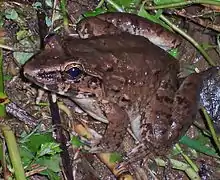 | |
| Fanged river frog (Limnonectes macrodon) | |
Scientific classification  | |
| Kingdom: | Animalia |
| Phylum: | Chordata |
| Class: | Amphibia |
| Order: | Anura |
| Family: | Dicroglossidae |
| Subfamily: | Dicroglossinae |
| Genus: | Limnonectes Fitzinger, 1843 |
| Species | |
|
More than 74, see text | |
| Synonyms | |
|
Taylorana Dubois, 1986 | |
Habitat
These frogs are found throughout East and Southeast Asia, most commonly near forest streams. Multiple species of Limnonectes may occupy the same area in harmony.[3] Large-bodied species cluster around fast rivers, while smaller ones live among leaf-litter or on stream banks. The Indonesian island of Sulawesi is home to at least 15 species of this frog, only four of which have been formally described.[4]
Lifecycle
Tadpoles of this genus have adapted to a variety of conditions. Most species (e.g. Blyth's river frog L. blythii or the fanged river frog L. macrodon) develop normally, with free-swimming tadpoles that eat food.[5] The tadpoles of the corrugated frog (L. laticeps) are free-swimming but endotrophic, meaning they do not eat but live on stored yolk until metamorphosis into frogs.[5] Before, L. limborgi was assumed to have direct development (eggs hatching as tiny, full-formed frogs), but more careful observations have showed it has free-swimming but endotrophic larvae; this probably applies to the closely related L. hascheanus, too.[6] L. larvaepartus is the only known species of frog that gives live birth to tadpoles.[4] Parental care is performed by males.[3]
Species
- Limnonectes acanthi (Taylor, 1923) – Busuanga wart frog
- Limnonectes arathooni (Smith, 1927) – Djikoro wart frog; (Endangered)
- Limnonectes asperatus
- Limnonectes bannaensis Ye, Fei, Xie & Jiang, 2007
- Limnonectes beloncioi Herr, Vallejos, Meneses, Abraham, Otterholt, Siler, Rico & Brown, 2021 – Mindoro fanged frog[7]
- Limnonectes blythii – Blyth's river frog, giant Asian river frog
- Limnonectes cintalubang (Matsui, Nishikawa & Eto, 2014)
- Limnonectes coffeatus Phimmachak, Sivongxay, Seateun, Yodthong, Rujirawan, Neang, Aowphol, and Stuart, 2018
- Limnonectes conspicillatus (Günther, 1872)
- Limnonectes dabanus
- Limnonectes dammermani – Dammerman's wart frog
- Limnonectes deinodon Dehling, 2014
- Limnonectes diuatus – eastern Mindanao frog, Tagibo wart frog
- Limnonectes doriae – Burmese wart frog, Doria's frog, or red stream frog
- Limnonectes fastigatus Stuart, Schoen, Nelson, Maher, Neang, Rowley & McLeod, 2020
- Limnonectes ferneri
- Limnonectes finchi – Finch's wart frog
- Limnonectes fragilis
- Limnonectes fujianensis
- Limnonectes grunniens
- Limnonectes gyldenstolpei
- Limnonectes hascheanus (sometimes separated in Taylorana)
- Limnonectes heinrichi
- Limnonectes hikidai Matsui & Nishikawa, 2014
- Limnonectes ibanorum
- Limnonectes ingeri
- Limnonectes isanensis McLeod, Kelly, and Barley, 2012
- Limnonectes jarujini Matsui et al., 2010
- Limnonectes kadarsani
- Limnonectes kenepaiensis
- Limnonectes khammonensis
- Limnonectes khasianus
- Limnonectes kiziriani Pham, Le, Ngo, Ziegler, and Nguyen, 2018
- Limnonectes kohchangae
- Limnonectes kong Dehling and Dehling, 2017
- Limnonectes kuhlii – Kuhl's Creek frog, large-headed frog
- Limnonectes larvaepartus
- Limnonectes lauhachindai (Aowphol, Rujirawan, Taksintum, Chuaynkern & Stuart. 2015)
- Limnonectes leporinus – giant river frog
- Limnonectes leytensis – small disked frog, swamp frog
- Limnonectes limborgi
- Limnonectes liui (Yang, 1983)
- Limnonectes longchuanensis (Suwannapoom, Yuan, Sullivan & McLeod, 2016)
- Limnonectes macrocephalus – Luzon fanged frog
- Limnonectes macrodon – fanged river frog, Javan giant frog, Malaya wart frog, stone creek frog
- Limnonectes macrognathus
- Limnonectes magnus – giant Philippine frog, large swamp frog, Mindanao fanged frog
- Limnonectes malesianus – Malesian frog, peat swamp frog
- Limnonectes mawlyndipi
- Limnonectes megastomias McLeod, 2008
- Limnonectes micrixalus
- Limnonectes microdiscus
- Limnonectes microtympanum
- Limnonectes mocquardi (Mocquard, 1890)
- Limnonectes modestus
- Limnonectes namiyei – Namiye's frog
- Limnonectes nguyenorum
- Limnonectes nitidus
- Limnonectes palavanensis
- Limnonectes paramacrodon
- Limnonectes parvus – Philippine small-disked frog
- Limnonectes plicatellus
- Limnonectes poilani
- Limnonectes quangninhensis Pham, Le, Nguyen, Ziegler, Wu, and Nguyen, 2017
- Limnonectes rhacoda
- Limnonectes savan Phimmachak, Richards, Sivongxay, Seateun, Chuaynkern, Makchai, Som & Stuart, 2019
- Limnonectes selatan Matsui, Belabut, and Ahmad, 2014
- Limnonectes shompenorum
- Limnonectes sinuatodorsalis Matsui, 2015
- Limnonectes sisikdagu McLeod, Horner, Husted, Barley, and Iskandar, 2011
- Limnonectes taylori Matsui et al., 2010
- Limnonectes timorensis (Smith, 1927)
- Limnonectes tweediei
- Limnonectes utara Matsui, Belabut, and Ahmad, 2014
- Limnonectes visayanus – giant Visayan frog
- Limnonectes woodworthi – Woodworth's frog
Phylogeny
Pyron & Wiens (2011)
The following phylogeny of Limnonectes is from Pyron & Wiens (2011).[8] 35 species are included. Limnonectes is a sister group of Nanorana.[8]
| Limnonectes |
| |||||||||||||||||||||||||||||||||||||||||||||||||||||||||||||||||||||||||||||||||||||||||||||||||||||||||||||||||||||||||||||||||||||||||||||||||||||||||||||||||||||||||||||||||||||||||||||||||||||||||||||||
Aowphol, et al. (2015)
The following Limnonectes phylogeny is from Aowphol, et al. (2015).[9] 20 species are included.
| Limnonectes |
| ||||||||||||||||||||||||||||||||||||||||||||||||||||||||||||||||||||||||||||||||||||||||||||||||||||||||||||
McLeod, et al. (2015)
Below is a phylogeny of species within the L. kuhlii species complex (McLeod, et al. 2015).[10] Limnonectes longchuanensis, Limnonectes hikidai, and Limnonectes cintalubang[11] are also part of the L. kuhlii species complex.
| |||||||||||||||||||||||||||||||||||||||||||||||||||||||
References
- Frost, Darrel R. (2014). "Limnonectes Fitzinger, 1843". Amphibian Species of the World: an Online Reference. Version 6.0. American Museum of Natural History. Retrieved 26 January 2014.
- Stuart, Bryan L.; Schoen, Sara N.; Nelson, Emma E.M.; Maher, Heather; Neang, Thy; Rowley, Jodi J.L.; Mcleod, David S. (2020-12-10). "A new fanged frog in the Limnonectes kuhlii complex (Anura: Dicroglossidae) from northeastern Cambodia". Zootaxa. 4894 (3): 451–473. doi:10.11646/zootaxa.4894.3.11. ISSN 1175-5334. PMID 33311078. S2CID 229178977.
- McLeod, D.S.; S.J. Horner; C. Husted; A. Barley & D.T. Iskandar (2011). "Same-same, but different: An unusual new species of the Limnonectes kuhlii Complex from West Sumatra (Anura: Dicroglossidae)" (PDF). Zootaxa. 2883: 52–64. doi:10.11646/zootaxa.2883.1.4. Archived from the original (PDF) on 2015-01-03.
- Iskandar, D. T.; Evans, B. J.; McGuire, J. A. (2014). "A Novel Reproductive Mode in Frogs: A New Species of Fanged Frog with Internal Fertilization and Birth of Tadpoles". PLOS ONE. 9 (12): e115884. Bibcode:2014PLoSO...9k5884I. doi:10.1371/journal.pone.0115884. PMC 4281041. PMID 25551466.
- Ming, Leong Tzi (2004). "Larval descriptions of some poorly known tadpoles from Peninsular Malaysia (Amphibia: Anura)" (PDF). Raffles Bulletin of Zoology. 52 (2): 609–620. Archived from the original (PDF) on 2007-06-17.
- Rowley, J. J. L.; Altig, R. (2012). "Nidicolous development in Limnonectes limborgi (Anura, Dicroglossidae)". Amphibia-Reptilia. 33: 145–149. doi:10.1163/156853812X626179.
- Freaky Fanged Frog Discovered in the Philippines. On: SciTechDaily; August 21, 2021
- R. Alexander Pyron; John J. Wiens (2011). "A large-scale phylogeny of Amphibia including over 2800 species, and a revised classification of extant frogs, salamanders, and caecilians". Molecular Phylogenetics and Evolution. 61 (2): 543–583. doi:10.1016/j.ympev.2011.06.012. PMID 21723399.
- Aowphol, Rujirawan, Taksintum, Chuaynkern, and Stuart, 2015, Zootaxa, 3956: 259. Holotype: NCSM 80222, by original designation. Type locality: "Thailand, Ubon Ratchathani Province, Sirindhorn District, Kham Khuen Kaew Subdistrict, 15°17’47.6”N 105°28’22.0”E, 131 m elev." zoobank.org/urn:lsid:zoobank.org:pub:270500F3-C33E-434B-B5F1-1FDB7A856AD9
- McLeod, Kurlbaum & Hoang, 2015 : More of the same: a diminutive new species of the Limnonectes kuhlii complex from northern Vietnam (Anura: Dicroglossidae). Zootaxa, No. 3947, p. 201–214.
- Matsui, Nishikawa, and Eto, 2014, Raffles Bull. Zool., Singapore, 62: 681. Holotype: KUHE 47859, by original designation. Type locality: "Ranchan, Serian, Samarahan Division, Sarawak, East Malaysia (01° 08′ 30″ N, 110° 34′ 57″ E, 64 m asl)". http://zoobank.org/urn:lsid:zoobank.org:pub:9C21B7C4-27AD-4103-89C0-513D2E80106C
 |
Wikimedia Commons has media related to Limnonectes. |