Hashomer Hatzair Workers Party
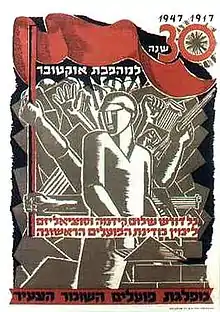
The Hashomer Hatzair Workers Party of Palestine (Hebrew: מִפְלֶגֶת פּוֹעָלִים הַשׁוֹמֵר הַצָעִיר בְּאֶרֶץ יִשְׂרָאֵל Mifleget Poalim Hashomer Hatzair be'Eretz Yisrael) was a Marxist-Zionist political party in the British Mandate of Palestine, connected to the Hashomer Hatzair movement.
Hashomer Hatzair Workers Party מפלגת פועלים השומר הצעיר | |
|---|---|
 | |
| Leader | Meir Ya'ari Ya'akov Hazan |
| Founded | 1946 |
| Merger of | Socialist League of Palestine |
| Merged into | Mapam |
| Ideology | Marxism Zionism |
| Election symbol | |
| ש | |
History
At the time of its foundation, in 1946, the party had around 10,000 members, two-thirds of whom hailed from the Kibbutz Artzi movement. The remainder came from the urban-based Socialist League of Palestine, which was dissolved into the party.[1][2]
The Hashomer Hatzair movement had positioned itself politically between the moderate mainstream Mapai and the radical communists since the 1920s. The movement had however been reluctant to form a political party, since its leaders had felt that entering into party politics could push the movement into ideological deviations.[3] The movement had tried to seek unity with Mapai and Ahdut HaAvoda before forming a party of its own, but those merger talks had failed as the other parties rejected the bi-nationalist positions of Hashomer Hatzair.[4]
In contrast with Mapai, the main Labour Zionist party in Palestine at the time, the Hashomer Hatzair Workers Party put heavier emphasis on class struggle.[5] The party could not achieve unity in action with the Communist Party, as the Hashomer Hatzair Workers Party supported aliyah whilst the communists had ambiguous positions on the issue.[6]
The Hashomer Hatzair Workers Party was the sole Zionist political organization in Palestine at the time that recognized the national rights of the Palestinian Arabs.[7] The party advocated a bi-national state, to be shared between Jews and Arabs. The party was repeatedly criticized by other Zionist groups for their bi-national position, accusing the party of breaking the united Zionist front. The party opposed partitioning Palestine, instead preferring converting the British Mandate into an international trusteeship. In the longer perspective, a 'Palestinian Commonwealth' with Jewish majority would be established. The party maintained links with Ihud, a small circle of Jewish intellectuals who shared the bi-national vision of the party.[7][8][9]
In 1948 the party merged with Ahdut HaAvoda-Poalei Zion, forming the United Workers Party (MAPAM).[1]
The party's newspaper was Al HaMishmar which subsequently transferred its affiliation to MAPAM.
References
- Beinin, Joel. Was the Red Flag Flying There?: Marxist Politics and the Arab-Israeli Conflict in Egypt and Israel, 1948–1965. Berkeley: University of California Press, 1990. pp. 26–27
- Sicker, Martin. Pangs of the Messiah: The Troubled Birth of the Jewish State. Westport, Conn: Praeger, 2000. p. 199.
- Tessler, Mark A. A history of the Israeli-Palestinian conflict. Indiana series in Arab and Islamic studies. Bloomington [u.a.]: Indiana Univ. Pr, 1994. p. 200
- Heller, Joseph. The Birth of Israel, 1945–1949: Ben-Gurion and His Critics. Gainesville: University Press of Florida, 2000. p. 198
- Gal, Allon. Socialist Zionism: theory and issues in contemporary Jewish Nationalism. Cambridge, Mass: Schenkman Pub. Co, 1973. p. 188
- Heller, Joseph. The Birth of Israel, 1945–1949: Ben-Gurion and His Critics. Gainesville: University Press of Florida, 2000. p. 202
- Beinin, Joel. Was the Red Flag Flying There?: Marxist Politics and the Arab-Israeli Conflict in Egypt and Israel, 1948–1965. Berkeley: University of California Press, 1990. pp. 27–28
- "William Gorman: Four Recent Books on Palestine (March 1947)".
- "Archived copy". Archived from the original on 2008-01-11. Retrieved 2009-02-06.
{{cite web}}: CS1 maint: archived copy as title (link)
Further reading
- The Case for a Bi-National Palestine: Memorandum Rep. Tel-Aviv: Executive Committee of the Hashomer Hatzair, 1946.