Lactobacillaceae
The Lactobacillaceae are a family of lactic acid bacteria.[3] It is the only family in the lactic acid bacteria which includes homofermentative and heterofermentative organisms;[4] in the Lactobacillaceae, the pathway used for hexose fermentation is a genus-specific trait. Lactobacillaceae include the homofermentative lactobacilli Lactobacillus, Holzapfelia, Amylolactobacillus, Bombilactobacillus, Companilactobacillus, Lapidilactobacillus, Agrilactobacillus, Schleiferilactobacillus, Loigolactobacillus, Lacticaseibacillus, Latilactobacillus, Dellaglioa, Liquorilactobacillus, Ligilactobacillus, and Lactiplantibacillus; the heterofermentative lactobacilli Furfurilactobacillus, Paucilactobacillus, Limosilactobacillus, Fructilactobacillus, Acetilactobacillus, Apilactobacillus, Levilactobacillus, Secundilactobacillus, and Lentilactobacillus, which were previously classified in the genus Lactobacillus; and the heterofermentative genera Convivina, Fructobacillus, Leuconostoc, Oenococcus, and Weissella which were previously classified in the Leuconostocaceae.[2]
| Lactobacillaceae | |
|---|---|
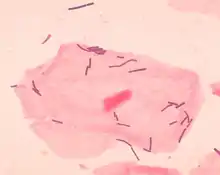 | |
| Lactobacillus near a squamous epithelial cell | |
Scientific classification  | |
| Domain: | Bacteria |
| Phylum: | Bacillota |
| Class: | Bacilli |
| Order: | Lactobacillales |
| Family: | Lactobacillaceae Winslow et al. 1917 (Approved Lists 1980) |
| Type genus | |
| Lactobacillus Beijerinck 1901 (Approved Lists 1980) | |
| Genera[1][2] | |
| |
| Synonyms[2] | |
| |
The Lactobacillaceae are also the only family in the of the lactic acid bacteria which does not include pathogenic or opportunistic pathogenic organisms although some species, particularly Lacticaseibacillus rhamnosus and Weissella spp. can cause rare infections in critically ill patients.[5][6]
With the exception of Lactococcus lactis, Streptococcus thermophilus and Tetragenococcus halophilus, most food fermenting lactic acid bacteria are now classified in the Lactobacillaceae.[2][7][8]
The grandfathered term lactobacilli refers to all bacteria classified in Lactobacillaceae prior to 2020, i.e. Lactobacillus sensu lato (pre-split), Pediococcus, and Sharpea.[2] Some authors use lactobacilli to refer to Lactobacillus sensu lato only.
Leuconostocaceae
At one point five genera (Convivina, Fructobacillus, Leuconostoc, Oenococcus and Weissella) were considered a separate family called Leuconostocaceae.[9] These three genera are non-spore-forming, round or elongated in shape, and anaerobic or aerotolerant. They usually inhabit nutrient-rich environments such as milk, meat, vegetable products, and fermented drinks.[10][11] Lactic acid is the main end product of their characteristic heterofermentative carbohydrate metabolism. In 2020 Leuconostocaceae was synonymized with Lactobacillaceae.[2]
Phylogeny
The currently accepted taxonomy is based on the List of Prokaryotic names with Standing in Nomenclature[1] and the phylogeny is based on whole-genome sequences.[2]
| ||||||||||||||||||||||||||||||||||||||||||||||||||||||||||||||||||||||||||||||||||||||||||||||||||||||||||||||||||||||||||||||||||||||||||||||||||||||||||||||||||||||||||||||||||||||||||||
References
- Euzéby JP, Parte AC. "Lactobacillaceae". List of Prokaryotic names with Standing in Nomenclature (LPSN). Retrieved June 30, 2021.
- Zheng J, Wittouck S, Salvetti E, Franz CMAP, Harris HMB, Mattarelli P, O'Toole PW, Pot B, Vandamme P, Walter J, Watanabe K, Wuyts S, Felis GE, Gänzle MG, Lebeer S. (2020). "A taxonomic note on the genus Lactobacillus: Description of 23 novel genera, emended description of the genus Lactobacillus Beijerinck 1901, and union of Lactobacillaceae and Leuconostocaceae". Int J Syst Evol Microbiol. 70 (4): 2782–2858. doi:10.1099/ijsem.0.004107. PMID 32293557.
- "Lactobacillaceae - Definition and More from Merriam-Webster's Free Medical Dictionary". Merriam-Webster Online. Retrieved 26 July 2010.
- Gänzle, Michael G (2015). "Lactic metabolism revisited: metabolism of lactic acid bacteria in food fermentations and food spoilage". Current Opinion in Food Science. Food Microbiology • Functional Foods and Nutrition. 2: 106–117. doi:10.1016/j.cofs.2015.03.001. ISSN 2214-7993.
- Ricci, Antonia; Allende, Ana; Bolton, Declan; Chemaly, Marianne; Davies, Robert; Girones, Rosina; Herman, Lieve; Koutsoumanis, Konstantinos; Lindqvist, Roland; Nørrung, Birgit; Robertson, Lucy (2017). "Scientific Opinion on the update of the list of QPS-recommended biological agents intentionally added to food or feed as notified to EFSA". EFSA Journal. 15 (3): e04664. doi:10.2903/j.efsa.2017.4664. ISSN 1831-4732. PMC 7010101. PMID 32625421.
- Abriouel, Hikmate; Lerma, Leyre Lavilla; Casado Muñoz, María del Carmen; Montoro, Beatriz Pérez; Kabisch, Jan; Pichner, Rohtraud; Cho, Gyu-Sung; Neve, Horst; Fusco, Vincenzina; Franz, Charles M. A. P.; Gálvez, Antonio (2015). "The controversial nature of the Weissella genus: Technological and functional aspects versus whole genome analysis-based pathogenic potential for their application in food and health". Frontiers in Microbiology. 6: 1197. doi:10.3389/fmicb.2015.01197. ISSN 1664-302X. PMC 4621295. PMID 26579103.
- Gänzle, Michael (2019), "Fermented Foods", Food Microbiology, John Wiley & Sons, Ltd, pp. 855–900, doi:10.1128/9781555819972.ch33, ISBN 978-1-68367-047-6, S2CID 242940113, retrieved 2020-11-28
- Hutkins, Robert W., ed. (2018). Microbiology and Technology of Fermented Foods (2nd ed.). doi:10.1002/9780470277515. ISBN 9780470277515.
- Chelo, Ivo M.; Zé-Zé, Líbia; Tenreiro, Rogério (2007). "Congruence of evolutionary relationships inside the Leuconostoc-Oenococcus-Weissella clade assessed by phylogenetic analysis of the 16S rRNA gene, dnaA, gyrB, rpoC and dnaK". International Journal of Systematic and Evolutionary Microbiology. 57 (2): 276–86. doi:10.1099/ijs.0.64468-0. PMID 17267964.
- Björkroth, Johanna; Holzapfel, Wilhelm (2006). "Genera Leuconostoc, Oenococcus and Weissella". The Prokaryotes. pp. 267–319. doi:10.1007/0-387-30744-3_9. ISBN 978-0-387-25494-4.
- Mohammad, Salma Malihah; Mahmud-Ab-Rashid, Nor-Khaizura; Zawawi, Norhasnida (2020-08-25). "Probiotic properties of bacteria isolated from bee bread of stingless bee Heterotrigona itama". Journal of Apicultural Research. 60: 172–187. doi:10.1080/00218839.2020.1801152. ISSN 0021-8839. S2CID 225208290.