Lycopsis
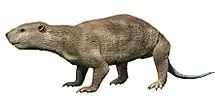
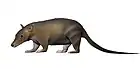
Lycopsis is an extinct genus of South American metatherian, that lived during the Miocene in Argentina and Colombia.[1]
| Lycopsis | |
|---|---|
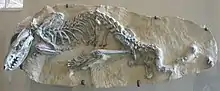 | |
| Fossil of L. longirostrus | |
| Scientific classification | |
| Kingdom: | |
| Phylum: | |
| Class: | |
| Order: | |
| Superfamily: | †Borhyaenoidea |
| Genus: | †Lycopsis Cabrera 1927 |
| Species | |
| |
| Synonyms | |
| |
History
Although not named until 1927, Florentino Ameghino described a species now seen as synonymous with Lycopsis torresi, Anatherium oxyrhynchus, in 1895 based on a mandibular ramus with several teeth.[2][3] The fossil was recovered from Puesto Estancia La Costa in Santa Cruz, Argentina, dating to the Miocene.[3] The type material of Lycopsis was collected in July of 1895 by "C. Berry" from the middle Miocene strata of the Santa Cruz Formation along the Santa Cruz River in the same area.[2][4] The fossils (MLP 11-113) were fragmentary, constituting only several fragmentary jaw sections from the maxilla and mandible, including several molars.[4][5] However, these fossils weren't named until in 1927, Angelo Cabrera named Lycopsis torresi, the generic name meaning "wolf-like aspect" after the anatomy of the mandible and the specific name after Argentine paleontologist and the director of the Museo de la Plata at the time, Luis Maria Torres.[4]
Taxonomy
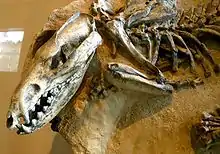
The cladogram after the analysis of Suárez et al., 2015, looks as follows:[6]
| Sparassodonta |
| ||||||||||||||||||||||||||||||||||||||||||||||||||||||||||||||||||||||||||||||||||||||||||||||||||||||||||||||||||||||||||||||
Distribution
Fossils of Lycopsis have been found in:[3]
- Arroyo Chasicó Formation and Santa Cruz Formations, Argentina
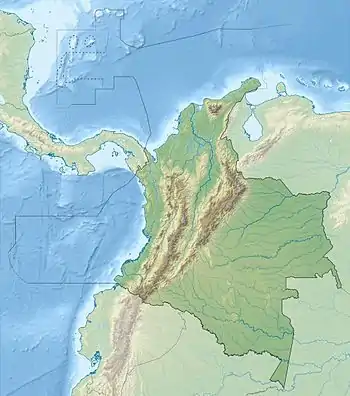
- Honda Group, Colombia
References
- Argot, C. (2004). "Functional-adaptive analysis of the postcranial skeleton of a Laventan borhyaenoid, Lycopsis longirostris (Marsupialia, Mammalia)". Journal of Vertebrate Paleontology. 24 (3): 689–708. doi:10.1671/0272-4634(2004)024[0689:FAOTPS]2.0.CO;2.
- Marshall, L. G. (1977). A new species of Lycopsis (Borhyaenidae: Marsupialia) from the La Venta fauna (Late Miocene) of Colombia, South America. Journal of Paleontology, 633-642.
- Lycopsis at Fossilworks.org
- Cabrera, Á. (1927). Datos para el conocimiento de los dasiuroideos fósiles argentinos. Revista del Museo de la Plata, 30, 271-315.
- Argot, C. (2004). Functional-adaptive analysis of the postcranial skeleton of a Laventan borhyaenoid, Lycopsis longirostris (Marsupialia, Mammalia). Journal of Vertebrate Paleontology, 24(3), 689-708.
- Suárez, C.; Forasiepi, A. M.; Goin, F. J.; Jaramillo, C. (2015). "Insights into the Neotropics prior to the Great American Biotic Interchange: new evidence of mammalian predators from the Miocene of Northern Colombia". Journal of Vertebrate Paleontology. 36: e1029581. doi:10.1080/02724634.2015.1029581. S2CID 86264178.
| |||||||||||||||||||||||||||||||||||||||||||||||||
| |||||||||||||||||||||||||||||||||||||||||||||||||
| |||||||||||||||||||||||||||||||||||||||||||||||||
| |||||||||||||||||||||||||||||||||||||||||||||||||
Paleontology in Colombia | |||||||||||||
|---|---|---|---|---|---|---|---|---|---|---|---|---|---|
| Notable researchers |
|        .jpg.webp)  | |||||||||||
| Major fossiliferous stratigraphic units |
| ||||||||||||
| Notable fossils | |||||||||||||

