Platypterygius
Platypterygius is a historically paraphyletic genus of platypterygiine ichthyosaur from the Cretaceous period. It was historically used as a wastebasket taxon, and most species within Platypterygius likely are undiagnostic at the genus or species level, or represent distinct genera. While fossils referred to Platypterygius have been found throughout the Early and the beginning of the Late Cretaceous, the holotype specimen was found in Germany.
| Platypterygius | |
|---|---|
.jpg.webp) | |
| Skull of P. sp., Sternberg Museum of Natural History | |
Scientific classification  | |
| Kingdom: | Animalia |
| Phylum: | Chordata |
| Class: | Reptilia |
| Order: | †Ichthyosauria |
| Family: | †Ophthalmosauridae |
| Subfamily: | †Platypterygiinae |
| Genus: | †Platypterygius von Huene, 1922 |
| Type species | |
| †Ichthyosaurus platydactylus Broilli 1907 | |
| Other species | |
| |
Description
As Platypterygius contains multiple species not especially close to each other, little can be said in terms of shared characteristics. According to an analysis by Fischer (2012), all anatomical features used to unify Platypterygius species are either not actually present in each species, or much more widespread among unrelated ophthalmosaurs. Generally, species referred to this genus were large bodied macropredators based on their robust dentition.[1] This is also supported by P. australis having been found with remains of sea turtles and birds (specifically, of the genus Nanantius) in its guts,[2] as well as an unidentified pterosaur fossil with tooth marks that may be from this genus.
Discovery and species
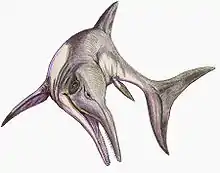
The type species of Platypterygius was described in 1922 based on remains found in upper Aptian strata around Hannover, Germany. These remains however were not adequately described and to complicate matters further, destroyed during World War 2. In the time after its discovery however Platypterygius has become a catch-all genus for Cretaceous ichthyosaurs, creating the misconstrued view of post-Jurassic ichthyosaurs as being a single global genus lacking in diversity. Later research conducted in the 2000s and 2010s has repeatedly shown this to be false, with all of the autapomorphies previously used to define Platypterygius either not being present in all assigned species or also being present in other ophthalmosaurids.[3] As the holotype was destroyed, a redescription of the material attempting to identify valid autapomorphies is out of the question and leaves the genus in a problematic state. Furthermore, the inclusion of later described genera of Cretaceous, platypterygiine ichthyosaurs has shown Platypterygius to be paraphyletic, with the different species not clading closely to one another. Subsequently, many redescriptions of referred Platypterygius species have found them to be their own distinct genera.
One notable attempt at revising Platypterygius was conducted by Arkhangel'sky in 1998, who split the genus into 3 new subgenera. Longirostria (including the Australian "P." longmani, a synonym of "P." australis, and the Argentinian "P." hautali), Tenuirostria ("P." americanus) and Pervushovisaurus (which included the newly described "P." bannovkensis). Both Platypterygius platydactylus,"P." kiprianoffi and "P." hercynicus were placed in the subgenus Platypterygius.[4]
"Platypterygius" bannovkensis was eventually elevated to its own genus Pervushovisaurus in 2014, utilizing Arkhangel'sky's proposed subgenus name[5] and "P." campylodon was also assigned to this genus by a study published in 2016.[6] Simbirskiasaurus was originally described in 1985 and later sunk into Platypterygius before being declared distinct in the same paper as Pervushovisaurus.[5] "Platypterygius" ochevi, described in 2008 by Arkhangel'sky et al., was found to be a junior synonym of Maiaspondylus cantabrigiensis[7] and in 2021 "Platypterygius" sachicarum was described by Cortés et al. as Kyhytysuka sachicarum.[8]
Species
- Platypterygius platydactylus Broilli, 1907 (type)
- Platypterygius americanus Nace, 1939 (=Tenuirostria)
- Platypterygius australis McCoy, 1867 (=Longirostria)
- Platypterygius hautali von Huene, 1927 (=Longirostria)
- Platypterygius hercynicus Kuhn, 1946
- Platypterygius kiprijanoffi Romer, 1968
Formerly assigned species
- Pervushovisaurus bannovkensis Arkhangelsky, 1998[9]
- Pervushovisaurus campylodon Carter, 1846[6]
- Simbirskiasaurus birjukovi Otschev and Efimov, 1985[9]
- Plutoniosaurus bedengensis Efimov, 1997
- Maiaspondylus cantabrigiensis (senior synonym of Platypterygius ochevi Arkhangelsky et al., 2008)
- Kyhytysuka sachicarum Cortés et al., 2021 (formerly Platypterygius sachicarum Páramo, 1997[10])
Classification
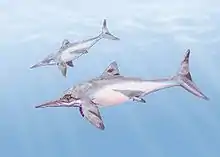
The following cladogram shows the internal relationships of ophthalmosaurian ichthyosaurs according to an analysis performed by Zverkov and Jacobs (2020).[11]
| Ophthalmosauria |
| ||||||||||||||||||||||||||||||||||||||||||||||||||||||||||||||||||||||||||||||||||||||||||||||||||||||||||||||||||||||||||||||||||||||||||||||||||||||||||||||||||||||||||||||||||||||||||||||||||||||||||||||||||||||||
References
- Fischer, V.; Bardet, N.; Benson, R.B.J.; Arkhangelsky, M.S.; Friedman, M. (2016). "Extinction of Fish-shaped Marine Reptiles Associated with Reduced Evolutionary Rates and Global Environmental Volatility". Nature Communications. 7: 10825. Bibcode:2016NatCo...710825F. doi:10.1038/ncomms10825. PMC 4786747. PMID 26953824.
- Kear, Benjamin P.; Boles, Walter E.; Smith, Elizabeth T. (2003). "Unusual gut contents in a Cretaceous ichthyosaur". Proceedings of the Royal Society B. 270 (Suppl 2): S206–S208. doi:10.1098/rsbl.2003.0050. PMC 1809966. PMID 14667384.
- Fischer, V. (2012). "New Data on the Ichthyosaur Platypterygius hercynicus and Its Implications for the Validity of the Genus". Acta Palaeontologica Polonica. 57 (1): 123–134. doi:10.4202/app.2011.0007. S2CID 53355007.
- Arkhangelsky, M.S. (1998). "On the Ichthyosaurian genus Platypterygius". Paleontological Journal. 32 (6): 611–615.
- Fischer, Valentin; Arkhangelsky, Maxim S.; Naish, Darren; Stenshin, Ilya M.; Uspensky, Gleb N.; Godefroit, Pascal (2014). "Simbirskiasaurus and Pervushovisaurus reassessed: implications for the taxonomy and cranial osteology of Cretaceous platypterygiine ichthyosaurs". Zoological Journal of the Linnean Society. 171 (4): 822–841. doi:10.1111/zoj.12158.
- Fischer, V. (2016). "Taxonomy of Platypterygius campylodon and the diversity of the last ichthyosaurs". PeerJ. 4: e2604. doi:10.7717/peerj.2604. PMC 5075704. PMID 27781178.
- Nikolay G. Zverkov; Dmitry V. Grigoriev (2020). "An unrevealed lineage of platypterygiines (Ichthyosauria) with peculiar forefin structure and semiglobal distribution in the mid-Cretaceous (Albian–Cenomanian)". Cretaceous Research. 115: Article 104550. doi:10.1016/j.cretres.2020.104550. S2CID 225721312.
- Cortés, D.; Maxwell, E.E.; Larsson, H.C.E. (2021). "Re-appearance of hypercarnivore ichthyosaurs in the Cretaceous with differentiated dentition revision of Platypterygius sachicarum (Reptilia:Ichthyosauria, Ophthalmosauridae) from Colombia". Journal of Systematic Palaeontology. 19 (14): 969–1002. doi:10.1080/14772019.2021.1989507. S2CID 244512087.
- Fischer, Valentin; Arkhangelsky, Maxim S.; Naish, Darren; Stenshin, Ilya M.; Uspensky, Gleb N.; Godefroit, Pascal (2014). "Simbirskiasaurus and Pervushovisaurus reassessed: implications for the taxonomy and cranial osteology of Cretaceous platypterygiine ichthyosaurs". Zoological Journal of the Linnean Society. 171 (4): 822–841. doi:10.1111/zoj.12158.
- Páramo, M.E. (1997). "Platypterygius sachicarum (Reptilia, Ichthyosauria) nueva especie del Cretácico de Colombia". Revista INGEOMINAS. 6: 1–12.
- Nikolay G. Zverkov; Megan L. Jacobs (2020). "Revision of Nannopterygius (Ichthyosauria: Ophthalmosauridae): reappraisal of the 'inaccessible' holotype resolves a taxonomic tangle and reveals an obscure ophthalmosaurid lineage with a wide distribution". Zoological Journal of the Linnean Society. 191: 228–275. doi:10.1093/zoolinnean/zlaa028.
Bibliography
- Arkhangelsky, M.S.; Averianov, A.O.; Pervushov, E.M.; Ratnikov, V. Yu; Zozyrev, N. Yu. (2008). "On ichthyosaur remains from the Cretaceous of the Voronezh region". Paleontological Journal. 42 (3): 287–291. doi:10.1134/S0031030108030106. S2CID 128822178.
- Druckenmiller, Patrick S.; Maxwell, Erin E. (2010). "A new Lower Cretaceous (lower Albian) ichthyosaur genus from the Clearwater Formation, Alberta, Canada". Canadian Journal of Earth Sciences. 47 (8): 1037–1053. Bibcode:2010CaJES..47.1037D. doi:10.1139/E10-028.
- Fernández, M. (2007). "Redescription and phylogenetic position of Caypullisaurus (Ichthyosauria: Ophthalmosauridae)". Journal of Paleontology. 81 (2): 368–375. doi:10.1666/0022-3360(2007)81[368:rappoc]2.0.co;2.
- Pardo Pérez, Judith; Frey, Eberhard; Stinnesbeck, Wolfgang; Fernández, Marta S.; Rivas, Luis; Salazar, Christian; Leppe, Marcelo (2012). "An ichthyosaurian forefin from the Lower Cretaceous Zapata Formation of southern Chile: implications for morphological variability within Platypterygius". Palaeoclimate, Palaeobiology, Paleoenvironments. 92 (2): 287–294. doi:10.1007/s12549-012-0074-8. S2CID 128487253. Retrieved 30 August 2016.
Further reading
- Long, J.A., Dinosaurs of Australia and New Zealand, UNSW Press, Australia 1998
External links
| |||||||||||||||||||||||||||||||||||||||||||||||||||||
| |||||||||||||||||||||||||||||||||||||||||||||||||||||
| |||||||||||||||||||||||||||||||||||||||||||||||||||||
| |||||||||||||||||||||||||||||||||||||||||||||||||||||
| |||||||||||||||||||||||||||||||||||||||||||||||||||||
Paleontology in Colombia | |||||||||||||
|---|---|---|---|---|---|---|---|---|---|---|---|---|---|
| Notable researchers |
|        .jpg.webp)  | |||||||||||
| Major fossiliferous stratigraphic units |
| ||||||||||||
| Notable fossils | |||||||||||||

