Ankylosaurinae
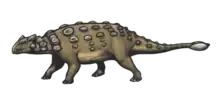
Ankylosaurinae is a subfamily of ankylosaurid dinosaurs, existing from the Early Cretaceous about 105 million years ago until the end of the Late Cretaceous, about 66 mya. Many genera are included in the clade, such as Ankylosaurus, Pinacosaurus, Euoplocephalus, and Saichania.
| Ankylosaurines Temporal range: Cretaceous, | |
|---|---|
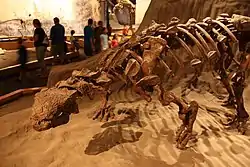 | |
| Skeleton of Scolosaurus thronus, once referred to Euoplocephalus. Royal Tyrrell Museum of Palaeontology | |
Scientific classification  | |
| Kingdom: | Animalia |
| Phylum: | Chordata |
| Clade: | Dinosauria |
| Order: | †Ornithischia |
| Clade: | †Thyreophora |
| Suborder: | †Ankylosauria |
| Family: | †Ankylosauridae |
| Subfamily: | †Ankylosaurinae Brown, 1908[1] |
| Genera[1] | |
| |
Features
Ankylosaurines are defined as being closer relatives to Ankylosaurus than to Shamosaurus.[2]
Diagnostic features of ankylosaurines include the nuchal shelf that obscures the occiput in dorsal view, and the quadrate condyle which is obscured lightly by the quadratojugal boss.[2]
Phylogeny
The following cladogram is based on the 50% majority rule phylogenetic analysis of Arbour & Currie (2015):[1]
| Ankylosaurinae |
| |||||||||||||||||||||||||||||||||||||||||||||||||||||||||||||||||||||||||||
References
- Arbour, Victoria M.; Currie, Philip J. (2015). "Systematics, phylogeny and palaeobiogeography of the ankylosaurid dinosaurs". Journal of Systematic Palaeontology. 14 (5): 1. doi:10.1080/14772019.2015.1059985. S2CID 214625754.
- Weishampel, David B.; Dodson, Peter; Osmólska, Halszka (2004). The Dinosauria. Berkeley, CA and Los Angeles, CA and London, England: University of California Press. pp. 389, 861. ISBN 0-520-24209-2. Retrieved April 9, 2010.
| |||||||||||||||||||||||||||||||||||||||||||
| |||||||||||||||||||||||||||||||||||||||||||
| |||||||||||||||||||||||||||||||||||||||||||
| |||||||||||||||||||||||||||||||||||||||||||
This article is issued from Wikipedia. The text is licensed under Creative Commons - Attribution - Sharealike. Additional terms may apply for the media files.