Azilestes
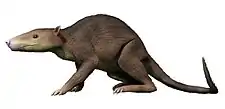
Azilestes ("Mas-d'Azil robber") is a genus of probable zhelestid eutherian mammal, a family consisting of small herbivores, that was discovered in the early Maastrichtian Grès de Labarre Formation of France.[2] It is a monotypic genus, with only type species A. ragei being known. Only one specimen, the holotype described in 2021, is known. It consists of a partial dentary with teeth.[2]
| Azilestes | |
|---|---|
Scientific classification  | |
| Kingdom: | Animalia |
| Phylum: | Chordata |
| Class: | Mammalia |
| Family: | †Zhelestidae |
| Genus: | †Azilestes Gheerbrant & Teodori, 2021 |
| Species: | †A. ragei |
| Binomial name | |
| †Azilestes ragei Gheerbrant & Teodori, 2021 | |
Certain aspects of Azilestes's dental anatomy are convergent with later groups of herbivorous mammals, including Glires, though phylogenetic analysis strongly suggests a position within the Zhelestidae.[2] It possesses bunodont molars, enlarged postfossids and hypoconids, an interradicular crest and radicular grooves, a unique combination among Cretaceous eutherians.[2]
History of discovery
The sole specimen and holotype of Azilestes, a partial dentary with teeth, was discovered in the Grès de Labarre Formation of the northern Pyrenees, near the Mas-d’Azil of the Ariège department in Occitanie region, France.[2] The specimen was found in the northeastern outcrops of the Grès de Labarre levels, northeast of the Mas-d’Azil, by surface prospecting in the area. The vertebrate-bearing level where it was found is a fossiliferous hard limestone, belonging to the upper unit of the Grès de Labarre which overlies the Marnes d’En locality.[2] Together with the overlying "Marnes Rouges Inférieures" formation, an eastern lateral equivalent of the Marnes d'Auzas, it comprises the last Cretaceous deposits of the Sub-Pyrenean zone.[2]
Azilestes was described by Emmanuel Gheerbrant and Dominique Teodori in 2021, and much of its anatomy was mapped using CT scanning.[2] It was named for Mas-d'Azil, the type locality, and the Greek λῃστήσ, or lestes ("robber"). The specific epithet is after Jean-Claude Rage, in tribute to his major contribution to the study of Cretaceous microvertebrates from Europe.[2]
Description
Though damaged and fragmentary, the sole specimen of Azilestes, dated to the early Maastrichtian,[2] is one of the most complete jaw remains of a eutherian reported from the Late Cretaceous of Europe. It preserves only part of the mandibular corpus, including the posterior part of the mandibular symphysis.[2] The symphysis extends far posteriorly, close to the level of the alveolus of the fourth upper molar, and is very compact. The mandibular corpus is dorso-ventrally high, and labially inflated.[2] It is convex below the molars, but below the premolars and the symphysis, it is concave. Its dorso-ventral depth decreases drastically at the length of the symphysis.[2]
The posterior mental foramen is rather large and located ventro-labially below and between the two roots of the fifth upper molar, as in most Cretaceous eutherians.[2] The dentary preserves two damaged molars and four well-developed empty anterior alveoli, interpreted as corresponding to two-rooted fifth upper molar, and a single-rooted fourth upper molar and canine.[2] Among Cretaceous eutherians, the molar morphology of the holotype most closely resembles the family Zhelestidae, to which it is tentatively assigned.[2] Zhelestids were non-placental eutherians, and were specialized for a herbivorous diet.[3]
The bunodont cusps and crowns, a shortened, robust dentary with reduced premolar formula, a small hypolophid and cingular-like postcristid and hypoconulid are unique among Cretaceous eutherians.[2] The closest eutherian to Azilestes, assuming a zhelestid identity, is Valentinella. However, the comparison of these two genera is limited due to the latter's poor preservation. Shared attributes include a possible hypocone, bunodont molar crowns with bulbous cusps, and a robust and deep mandibular corpus that is laterally convex.[2]
Taxonomy
Phylogenetic analyses within the paper variably suggest Azilestes to be part of a zhelestid polytomy which includes solenodons, a monophyletic Zhelestidae, or a basal member of Glires, though all but the latter recover it as the sister genus to Valentinella, and in one phylogeny, they are part of the Lainodontinae.[2] While a position within the Zhelestidae is most likely, Gheerbrant and Teodori (2021) assume a basal position within the Eutheria.[2]
Below is a phylogeny from Gheerbrant & Teodori (2021):[2]
| |||||||||||||||||||||||||||||||||||||||||||||||||||||||||||||||||||||||||||||||||||||||||||||||||||||||||||||||||||||||||||||||||||||||||||||||||||||||||||||||||||||||||||||||||||||||||||||||||||||||||||||||||||||||||||||||||||||||||||||||||||||||||||||||||||||||||||||||||||||||||||||||||||||||||||||||||||||||||||||||||||||||||||||||||||||||||||||||||||||||||||||||||||||||||||||||||||||||||||||||||||||||||||||||
Palaeoecology
The bunodont molars, the large postfossid and hypoconid, wear patterns, and the development of an interradicular crest and radicular grooves indicate a crushing-grinding function for Azilestes's teeth, possibly suggesting a durophagous lifestyle.[2]
Only three non-avian dinosaurs are known to have coexisted with Azilestes. These are the rhabdodontid Rhabdodon, cf. Ampelosaurus atacis, and an indeterminate nodosaurid.[4][1]
References
- Fossilworks: Maison Varin, Dreuilhe fossilworks.org. Retrieved 2021-03-29.
- Gheerbrant E. & Teodori D. 2021. — An enigmatic specialized new eutherian mammal from the Late Cretaceous of Western Europe (Northern Pyrenees), in Folie A., Buffetaut E., Bardet N., Houssaye A., Gheerbrant E. & Laurin M. (eds), Palaeobiology and palaeobiogeography of amphibians and reptiles: An homage to Jean-Claude Rage. Comptes Rendus Palevol 20 (13): 207-223. https://doi.org/10.5852/cr-palevol2021v20a13
- L. A. Nessov, J. D. Archibald, and Z. Kielan-Jaworowska. 1998. Ungulate-like mammals from the Late Cretaceous of Uzbekistan and a phylogenetic analysis of Ungulatomorpha. Bulletin of Carnegie Museum of Natural History 34:40-88
- Weishampel, David B; et al. (2004). "Dinosaur distribution (Late Cretaceous, Europe)." In: Weishampel, David B.; Dodson, Peter; and Osmólska, Halszka (eds.): The Dinosauria, 2nd, Berkeley: University of California Press. Pp. 588-593. ISBN 0-520-24209-2.
| |||||||||||||||||||||||||||||||||||||
| |||||||||||||||||||||||||||||||||||||
| |||||||||||||||||||||||||||||||||||||
| |||||||||||||||||||||||||||||||||||||
.png.webp)