Carnivoraformes
Carnivoraformes ("carnivora-shaped") is a clade of placental mammals that includes the modern order Carnivora and its extinct stem-relatives.
| Carnivoraformes | |
|---|---|
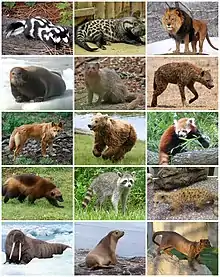 | |
| Diversity of Carnivorans | |
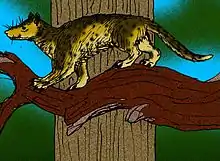 | |
| Miacis | |
Scientific classification  | |
| Kingdom: | Animalia |
| Phylum: | Chordata |
| Class: | Mammalia |
| Mirorder: | Ferae |
| Clade: | Pan-Carnivora |
| Clade: | Carnivoramorpha |
| Clade: | Carnivoraformes Flynn, 2010[1] |
| Subgroups | |
|
| |
Classification and phylogeny
Classification
In 2010 Flynn, Finarelli & Spaulding named a new clade Carnivoraformes within Carnivoramorpha, containing carnivorans and "miacids" but not viverravids.[1] The authors defined Carnivoraformes as the clade containing Carnivora and all taxa that are more closely related to Carnivora (represented by Canis lupus) than to viverravids (represented by Viverravus gracilis).
- Clade: Carnivoraformes
- Genus: †Africtis
- Genus: †Ceruttia
- Genus: †Dawsonicyon
- Genus: †Miacis
- Genus: †Prodaphaenus
- Genus: †Walshius
- (unranked): †Gracilocyon/Oodectes clade
- Genus: †Eogale
- Genus: †Gracilocyon
- Genus: †Oodectes
- Genus: †Paramiacis
- Genus: †Paroodectes
- (unranked): †Lycarion/Neovulpavus clade
- Genus: †Lycarion
- Genus: †Neovulpavus
- (unranked): †Uintacyon clade
- Genus: †Miocyon
- Genus: †Simamphicyon
- Genus: †Uintacyon
- Genus: †Zodiocyon
- Incertae sedis:
- †"Miacis" boqinghensis
- †"Miacis" invictus
- †"Miacis" lushiensis
- †"Miacis" thailandicus
- (unranked): †Vulpavus clade
- Genus: †Dormaalocyon
- Genus: †Vassacyon
- Genus: †Vulpavus
- Incertae sedis:
- †"Miacis" deutschi
- †"Miacis" exiguus
- Incertae sedis:
- †"Miacis" hookwayi
- †"Miacis" latidens
- †"Miacis" petilus
- Order: Carnivora (carnivorans)
- Suborder: Caniformia ("dog-like" carnivorans)
- Suborder: Feliformia ("cat-like" carnivorans)
Phylogenetic tree
The phylogenetic relationships of Carnivoraformes are shown in the following cladogram:[2][1][3][4][5][6][7][8][9][10]
| Carnivoramorpha |
| ||||||||||||||||||||||||||||||||||||||||||||||||||||||||||||||||||||||||||||||||||||||||||||||||||||||||||||||||||||||||||||||||||||||||||||||||||||||||||||||||||||||||||||
(Carnivora [sensu lato]) |

.png.webp)
.jpg.webp)
References
- John J. Flynn; John A. Finarelli; Michelle Spaulding (2010). "Phylogeny of the Carnivora and Carnivoramorpha, and the use of the fossil record to enhance understanding of evolutionary transformations". In Anjali Goswami; Anthony Friscia (eds.). Carnivoran evolution. New views on phylogeny, form and function. Cambridge University Press. pp. 25–63. doi:10.1017/CBO9781139193436.003. ISBN 9781139193436.
- Bryant, H.N., and M. Wolson (2004) “Phylogenetic Nomenclature of Carnivoran Mammals.” First International Phylogenetic Nomenclature Meeting. Paris, Museum National d’Histoire Naturelle
- Michelle Spaulding; John J. Flynn; Richard K. Stucky (2010). "A new basal Carnivoramorphan (Mammalia) from the 'Bridger B' (Black's Fork member, Bridger Formation, Bridgerian Nalma, middle Eocene) of Wyoming, USA". Palaeontology. 53 (4): 815–832. doi:10.1111/j.1475-4983.2010.00963.x.
- Susumu Tomiya (2011). "A new basal caniform (Mammalia: Carnivora) from the Middle Eocene of North America and remarks on the phylogeny of early carnivorans". PLOS ONE. 6 (9): e24146. Bibcode:2011PLoSO...624146T. doi:10.1371/journal.pone.0024146. PMC 3173397. PMID 21935380.
- Solé, Floréal; Smith, Richard; Coillot, Tiphaine; de Bast, Eric; Smith, Thierry (2014). "Dental and tarsal anatomy of Miacis latouri and a phylogenetic analysis of the earliest carnivoraforms (Mammalia, Carnivoramorpha)". Journal of Vertebrate Paleontology. 34 (1): 1–21. doi:10.1080/02724634.2013.793195. ISSN 0272-4634. S2CID 86207013.
- Wang, Jian; Zhang, Zhaoqun (2015). "Phylogenetic analysis on Palaeogale (Palaeogalidae, Carnivora) based on specimens from Oligocene strata of Saint-Jacques, Nei Mongol". Vertebrata PalAsiatica. 53 (4): 310–334.
- Solé, Floréal; Smith, Thierry; De Bast, Eric; Codrea, Vlad; Gheerbrant, Emmanuel (2016). "New carnivoraforms from the latest Paleocene of Europe and their bearing on the origin and radiation of Carnivoraformes (Carnivoramorpha, Mammalia)". Journal of Vertebrate Paleontology. 36 (2): e1082480. doi:10.1080/02724634.2016.1082480. ISSN 0272-4634. S2CID 87537565.
- Tomiya, Susumu; Tseng, Zhijie Jack (2016). "Whence the beardogs? Reappraisal of the Middle to Late Eocene 'Miacis' from Texas, USA, and the origin of Amphicyonidae (Mammalia, Carnivora)". Royal Society Open Science. 3 (10): 160518. Bibcode:2016RSOS....3p0518T. doi:10.1098/rsos.160518. ISSN 2054-5703. PMC 5098994. PMID 27853569.
- Solé, Floréal; Ladevèze, Sandrine (2017). "Evolution of the hypercarnivorous dentition in mammals (Metatheria,Eutheria) and its bearing on the development of tribosphenic molars". Evolution & Development. 19 (2): 56–68. doi:10.1111/ede.12219. PMID 28181377. S2CID 46774007.
- Prevosti, F. J., & Forasiepi, A. M. (2018). "Introduction. Evolution of South American Mammalian Predators During the Cenozoic: Paleobiogeographic and Paleoenvironmental Contingencies"