Neotheropoda
Neotheropoda (meaning "new theropods") is a clade that includes coelophysoids and more advanced theropod dinosaurs, and is the only group of theropods that survived the Triassic–Jurassic extinction event. All neotheropods became extinct by the end of the Early Jurassic period except for Averostra.
| Neotheropods | |
|---|---|
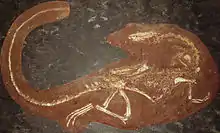 | |
| Cast of a Coelophysis bauri skeleton | |
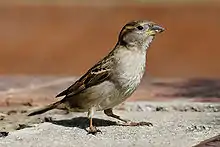 | |
| A female house sparrow (Passer domesticus) | |
Scientific classification  | |
| Kingdom: | Animalia |
| Phylum: | Chordata |
| Clade: | Dinosauria |
| Clade: | Saurischia |
| Clade: | Theropoda |
| Clade: | Neotheropoda Bakker, 1986 |
| Subgroups | |
| Synonyms | |
| |
Classification
Neotheropoda was named by Robert T. Bakker in 1986 as a group including the relatively derived theropod subgroups Ceratosauria and Tetanurae, and excluding coelophysoids.[1] However, most later researchers have used it to denote a broader group. Neotheropoda was first defined as a clade by Paul Sereno in 1998 as Coelophysis plus modern birds, which includes almost all theropods except the most primitive species.[2] Dilophosauridae was formerly considered a small clade within Neotheropoda, but was later considered to be paraphyletic.[3]
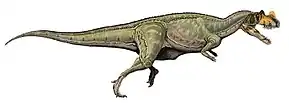
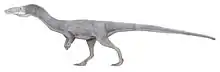
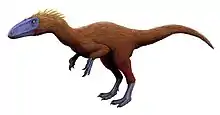
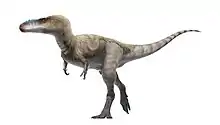
The following family tree illustrates a synthesis of the relationships of the early theropod groups compiled by Hendrickx et al. in 2015.[4]
| Theropoda |
| ||||||||||||||||||||||||||||||||||||||||||||||||||||||
.jpg.webp)
_(Antwerpener_Breiftaube).jpg.webp)
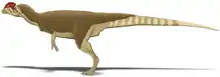
This second cladogram is based on the redescription of Dilophosaurus by Marsh and Rowe (2020).[3]
| Theropoda |
| |||||||||||||||||||||||||||||||||||||||||||||||||||||||||||||||
.PNG.webp)
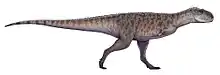
This third cladogram is based on the larger analysis in the description of Pendraig milnerae by Spiekman et al. 2021:[5]
| Theropoda |
| ||||||||||||||||||||||||||||||||||||||||||||||||||||||||||||||||||||||||||||||||||||||||||||||||
References
- Bakker, R.T. 1986. The Dinosaur Heresies. William Morrow, New York. 481 pp.
- Sereno, 1998. A rationale for phylogenetic definitions, with application to the higher-level taxonomy of Dinosauria. Neues Jahrbuch für Geologie und Paläontologie, Abhandlungen. 210, 41-83.
- Marsh, Adam D.; Rowe, Timothy B. (2020). "A comprehensive anatomical and phylogenetic evaluation of Dilophosaurus wetherilli (Dinosauria, Theropoda) with descriptions of new specimens from the Kayenta Formation of northern Arizona". Journal of Paleontology. doi:10.1017/jpa.2020.14.
- Hendrickx, C., Hartman, S.A., & Mateus, O. (2015). An Overview of Non- Avian Theropod Discoveries and Classification. PalArch’s Journal of Vertebrate Palaeontology, 12(1): 1-73.
- Spiekman SN, Ezcurra MD, Butler RJ, Fraser NC, Maidment SC (2021). "Pendraig milnerae, a new small-sized coelophysoid theropod from the Late Triassic of Wales". Royal Society Open Science. 8 (10): Article ID 210915. doi:10.1098/rsos.210915.
| |||||||||||||||||||||||||||||||||||||||||||||||||||||||||
| |||||||||||||||||||||||||||||||||||||||||||||||||||||||||
| |||||||||||||||||||||||||||||||||||||||||||||||||||||||||
| |||||||||||||||||||||||||||||||||||||||||||||||||||||||||
| |||||||||||||||||||||||||||||||||||||||||||||||||||||||||
| |||||||||||||||||||||||||||||||||||||||||||||||||||||||||
| |||||||||||||||||||||||||||||||||||||||||||||||||||||||||
.jpg.webp)
.png.webp)
.jpg.webp)