Tyrannoraptora
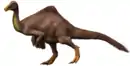
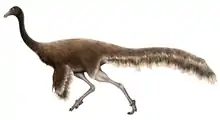
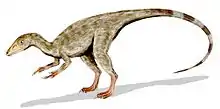
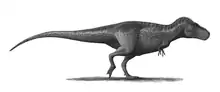
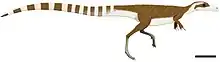
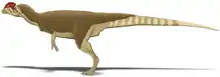
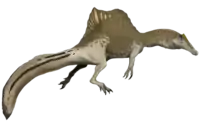
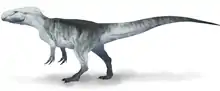
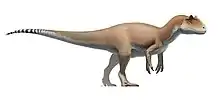
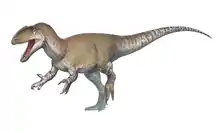
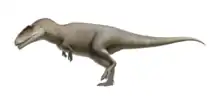
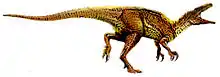
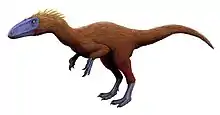
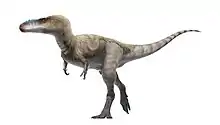
Tyrannoraptora is a clade defined as "all descendants of the last common ancestor of Tyrannosaurus rex and Passer domesticus (the house sparrow)".[2] The clade was named in 1999 by the American paleontologist Paul Sereno, though in his original concept had Tyrannosauroidea being the sister taxon to Pennaraptora (which in Serenos paper was synonyms with Maniraptora as Therizinosaurs more closely related to Ornithomimosaurs and the term Pennaraptora had not been coined as yet).[3] Phylogenetic analyses have since, however, found the group also encompasses Compsognathidae, Ornithomimosauria, Alvarezsauroidea, and Therizinosauria.[4][5][6] Thus tyrannoraptorans are divided into tyrannosauroids and maniraptoromorphs.
| Tyrannoraptorans | |
|---|---|
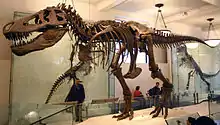 | |
| Skeleton mount of Tyrannosaurus rex | |
Scientific classification  | |
| Kingdom: | Animalia |
| Phylum: | Chordata |
| Clade: | Dinosauria |
| Clade: | Saurischia |
| Clade: | Theropoda |
| Clade: | Avetheropoda |
| Clade: | Coelurosauria |
| Clade: | Tyrannoraptora Sereno, 1999 |
| Subclades | |
The cladogram below shows Sereno's original concept for Tyrannoraptora.
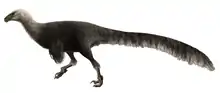
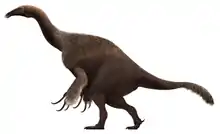
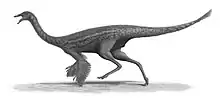
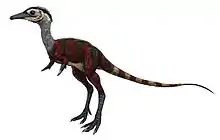
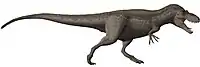
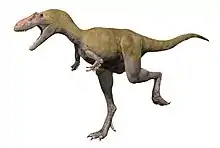
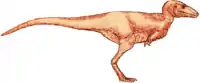
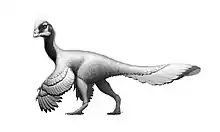
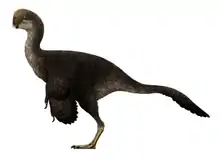
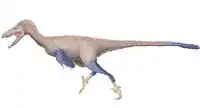

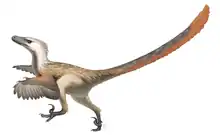

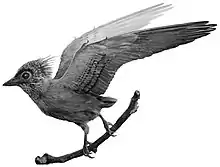
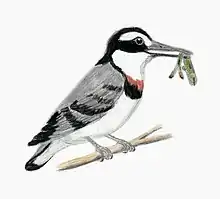

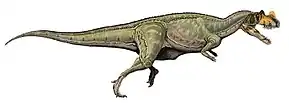
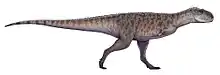
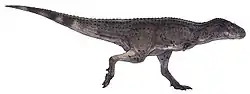
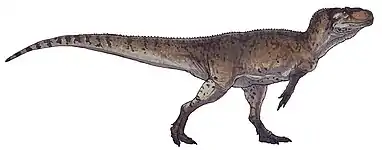
The Cladogram below shows the modern interpretation of Tyrannoraptora.[7]
| Coelurosauria |
| ||||||||||||||||||||||||||||||||||||||||||||||||
.jpg.webp)
.jpg.webp)
.png.webp)
_(Antwerpener_Breiftaube).jpg.webp)
References
- Hartman, Scott; Mortimer, Mickey; Wahl, William R.; Lomax, Dean R.; Lippincott, Jessica; Lovelace, David M. (2019). "A new paravian dinosaur from the Late Jurassic of North America supports a late acquisition of avian flight". PeerJ. 7: e7247. doi:10.7717/peerj.7247. PMC 6626525. PMID 31333906.
- Holtz Jr., T. R.; Molnar, R. E.; Currie, Phillip C. (2004). "Basal Tetanurae". In Weishampel, D. A.; Dodson, P.; Osmólska, H. (eds.). The Dinosauria, Second Edition. California: University of California Press. pp. 71–110. ISBN 0520254082.
- Sereno, P. C. (1999). "The evolution of dinosaurs". Science. 258 (5423): 2137–2147. doi:10.1126/science.284.5423.2137. PMID 10381873.
- Zelenitsky, D. K.; Therrien, F.; Erickson, G. M.; Debuhr, C. L.; Kobayashi, Y.; Eberth, D. A.; Hadfield, F. (2012). "Feathered Non-Avian Dinosaurs from North America Provide Insight into Wing Origins". Science. 338 (6106): 510–514. Bibcode:2012Sci...338..510Z. doi:10.1126/science.1225376. PMID 23112330. S2CID 2057698.
- Andrea Cau (2018). "The assembly of the avian body plan: a 160-million-year long process" (PDF). Bollettino della Società Paleontologica Italiana. 57 (1): 1–25. doi:10.4435/BSPI.2018.01.
- Hartman, Scott; Mortimer, Mickey; Wahl, William R.; Lomax, Dean R.; Lippincott, Jessica; Lovelace, David M. (2019). "A new paravian dinosaur from the Late Jurassic of North America supports a late acquisition of avian flight". PeerJ. 7: e7247. doi:10.7717/peerj.7247. PMC 6626525. PMID 31333906.
- Hendrickx, Mateus (2015). "An Overview of Non- Avian Theropod Discoveries and Classification". PalArch’s Journal of Vertebrate Palaeontology.
| |||||||||||||||||||||||||||||||||||||||||||||||||||||||||
| |||||||||||||||||||||||||||||||||||||||||||||||||||||||||
| |||||||||||||||||||||||||||||||||||||||||||||||||||||||||
| |||||||||||||||||||||||||||||||||||||||||||||||||||||||||
| |||||||||||||||||||||||||||||||||||||||||||||||||||||||||
| |||||||||||||||||||||||||||||||||||||||||||||||||||||||||
| |||||||||||||||||||||||||||||||||||||||||||||||||||||||||
.jpg.webp)
.jpg.webp)
.png.webp)
.jpg.webp)