Iota Mensae
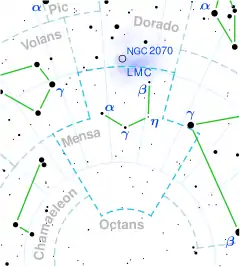
Iota Mensae is a single star about 880 light years away in the faint constellation Mensa. It has a very slightly variable apparent magnitude of 6.0, making it visible with the naked eye under good skies.
  | |
| Observation data Epoch J2000 Equinox J2000 | |
|---|---|
| Constellation | Mensa |
| Right ascension | 05h 35m 36.1787s[1] |
| Declination | −78° 49′ 15.129″[1] |
| Apparent magnitude (V) | 6.00 - 6.05[2] |
| Characteristics | |
| Spectral type | B8III[3] |
| B−V color index | −0.022[4] |
| Variable type | Ellipsoidal?[2] |
| Astrometry | |
| Radial velocity (Rv) | 12.60[5] km/s |
| Proper motion (μ) | RA: +4.437±0.210[1] mas/yr Dec.: +25.710±0.322[1] mas/yr |
| Parallax (π) | 3.7076 ± 0.1819 mas[1] |
| Distance | 880 ± 40 ly (270 ± 10 pc) |
| Absolute magnitude (MV) | −1.03[6] |
| Details | |
| Mass | 3.7[7] M☉ |
| Radius | 2.9[8] R☉ |
| Luminosity | 51.8[8] L☉ |
| Surface gravity (log g) | 3.40[7] cgs |
| Temperature | 10,094[7] K |
| Metallicity [Fe/H] | 0.14[7] dex |
| Age | 314[9] Myr |
| Other designations | |
| Database references | |
| SIMBAD | data |
Iota Mensae has a spectral type of B8III, indicating that it has exhausted hydrogen at its core and expanded away from the main sequence. It is about 3.7 times the mass (M☉), 52 times as luminous, and has swollen to 2.9 times the radius of the Sun (R☉). It is calculated to be 314 million years old. It has been catalogued as a chemically peculiar star with abnormally strong lines of silicon in its spectrum but this classification is now considered doubtful.[11] Its brightness varies by a few hundredths of a magnitude. Its period was initially measured at 2.6 days,[12] but this is now considered to be a period of 5.3 days with primary and secondary minima of a similar depth. The variability is thought to be due to the rotation of the star.[2]
References
- Brown, A. G. A.; et al. (Gaia collaboration) (2021). "Gaia Early Data Release 3: Summary of the contents and survey properties". Astronomy & Astrophysics. 649: A1. arXiv:2012.01533. Bibcode:2021A&A...649A...1G. doi:10.1051/0004-6361/202039657. S2CID 227254300. Gaia EDR3 record for this source at VizieR.
- Samus, N. N.; Durlevich, O. V.; et al. (2009). "VizieR Online Data Catalog: General Catalogue of Variable Stars (Samus+ 2007-2013)". VizieR On-line Data Catalog: B/GCVS. Originally Published in: 2009yCat....102025S. 1: B/gcvs. Bibcode:2009yCat....102025S.
- Houk, Nancy (1975). Michigan catalogue of two-dimensional spectral types for the HD stars. Vol. 1. Ann Arbor, Michigan: Dept. of Astronomy, University of Michigan. Bibcode:1975MSS...C01....0H.
- Høg, E.; et al. (2000). "The Tycho-2 catalogue of the 2.5 million brightest stars". Astronomy and Astrophysics. 355: L27–L30. Bibcode:2000A&A...355L..27H.
- Gontcharov, G. A. (2006). "Pulkovo Compilation of Radial Velocities for 35 495 Hipparcos stars in a common system". Astronomy Letters. 32 (11): 759–771. arXiv:1606.08053. Bibcode:2006AstL...32..759G. doi:10.1134/S1063773706110065. S2CID 119231169.
- Anderson, E.; Francis, Ch. (2012). "XHIP: An extended hipparcos compilation". Astronomy Letters. 38 (5): 331. arXiv:1108.4971. Bibcode:2012AstL...38..331A. doi:10.1134/S1063773712050015. S2CID 119257644.
- Anders, F.; Khalatyan, A.; Chiappini, C.; Queiroz, A. B.; Santiago, B. X.; Jordi, C.; Girardi, L.; Brown, A. G. A.; Matijevič, G.; Monari, G.; Cantat-Gaudin, T.; Weiler, M.; Khan, S.; Miglio, A.; Carrillo, I.; Romero-Gómez, M.; Minchev, I.; De Jong, R. S.; Antoja, T.; Ramos, P.; Steinmetz, M.; Enke, H. (2019). "Photo-astrometric distances, extinctions, and astrophysical parameters for Gaia DR2 stars brighter than G = 18". Astronomy and Astrophysics. 628: A94. arXiv:1904.11302. Bibcode:2019A&A...628A..94A. doi:10.1051/0004-6361/201935765.
- McDonald, I.; Zijlstra, A. A.; Watson, R. A. (2017). "Fundamental parameters and infrared excesses of Tycho–Gaia stars". Monthly Notices of the Royal Astronomical Society. 471 (1): 770–791. arXiv:1706.02208. Bibcode:2017MNRAS.471..770M. doi:10.1093/mnras/stx1433.
- Gontcharov, G. A. (2012). "Dependence of kinematics on the age of stars in the solar neighborhood". Astronomy Letters. 38 (12): 771–782. arXiv:1606.08814. Bibcode:2012AstL...38..771G. doi:10.1134/S1063773712120031. S2CID 118345778.
- "Iota Men". SIMBAD. Centre de données astronomiques de Strasbourg. Retrieved 2021-02-18.
- Renson, P.; Manfroid, J. (2009). "Catalogue of Ap, HGMN and Am stars". Astronomy and Astrophysics. 498 (3): 961. Bibcode:2009A&A...498..961R. doi:10.1051/0004-6361/200810788.
- Grønbech, B.; Naqvi, S. I. H. (1976). "HR 1991. A new variable B star". Astronomy and Astrophysics Supplement Series. 26: 147. Bibcode:1976A&AS...26..147G.
| Stars |
| ||||||||||
|---|---|---|---|---|---|---|---|---|---|---|---|
| |||||||||||
| |||||||||||
| |||||||||||
 Category Category | |||||||||||