Menefeeceratops
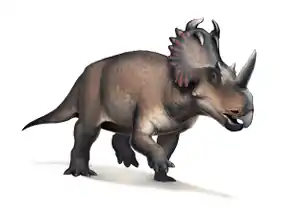
Menefeeceratops (meaning "Menefee Formation horned face") is a genus of ceratopsid dinosaur from the Menefee Formation in New Mexico, United States. It is potentially the oldest known member of the ceratopsids, as well as the centrosaurine subfamily, related to animals including Yehuecauhceratops and Crittendenceratops. The type and only species is Menefeeceratops sealeyi, known from a partial, non-articulated skeleton.[1]
| Menefeeceratops Temporal range: Campanian, | |
|---|---|
Scientific classification  | |
| Kingdom: | Animalia |
| Phylum: | Chordata |
| Clade: | Dinosauria |
| Order: | †Ornithischia |
| Suborder: | †Ceratopsia |
| Family: | †Ceratopsidae |
| Subfamily: | †Centrosaurinae |
| Genus: | †Menefeeceratops Dalman et al., 2021 |
| Type species | |
| †Menefeeceratops sealeyi Dalman et al., 2021 | |
Discovery and Naming
First described in scientific literature in 1997,[2] Menefeeceratops was not given a name until it was revisited in 2021 by Sebastian Dalman, Peter Dodson, and colleagues. The holotype specimen, NMMNH P-25052, was discovered in the Cretaceous rocks of the Menefee Formation. Menefeeceratops is named from the location where the fossils were found, and in honor of Paul Sealey, the research associate at the New Mexico Museum of Natural History and Science who discovered them in 1996.[1]
Description
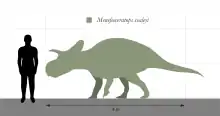
Based on comparisons with related animals including Styracosaurus, Vagaceratops, and Centrosaurus, Menefeeceratops is believed to have been approximately 4–4.5 metres (13–15 ft) long in life.[1]
| Centrosaurinae |
| ||||||||||||||||||||||||||||||||||||||||||||||||
See also
References
- Dalman, Sebastian G.; Lucas, Spencer G.; Jasinki, Steven G.; Lichtig, Asher J.; Dodson, Peter (2021). "The oldest centrosaurine: a new ceratopsid dinosaur (Dinosauria: Ceratopsidae) from the Allison Member of the Menefee Formation (Upper Cretaceous, early Campanian), northwestern New Mexico, USA". PalZ. 95 (2): 291–335. doi:10.1007/s12542-021-00555-w. S2CID 234351502.
- Williamson, TE (1997). "A new Late Cretaceous (early Campanian) vertebrate fauna from the Allison Member, Menefee Formation, San Juan Basin, New Mexico". In Lucas, SG; Estep, JW; Williamson, TE; Morgan, GS (eds.). New Mexico's Fossil Record 1. Albuquerque: New Mexico Museum of Natural History and Science Bulletin 11. pp. 51–59. Retrieved 21 April 2021..
| |||||||||||||||||||||||||||||||||||||||||||||||||
| |||||||||||||||||||||||||||||||||||||||||||||||||
| |||||||||||||||||||||||||||||||||||||||||||||||||
| |||||||||||||||||||||||||||||||||||||||||||||||||
.png.webp)