Radical 144
Radical 144 or radical walk enclosure (行部) meaning "go" or "do" is one of the 29 Kangxi radicals (214 radicals in total) composed of 6 strokes.
| 行 | ||
|---|---|---|
| ||
| 行 (U+884C) "go, do" | ||
| Pronunciations | ||
| Pinyin: | xíng, háng | |
| Bopomofo: | ㄒㄧㄥˋ, ㄏㄤˊ | |
| Wade–Giles: | hsing2 | |
| Cantonese Yale: | haang4, hang4, hang6, hong4 | |
| Jyutping: | haang4, hang4, hang6, hong4 | |
| Japanese Kana: | コウ kō / アン an (on'yomi) ゆ-く yu-ku / おこな-う okona-u (kun'yomi) | |
| Sino-Korean: | 행 haeng | |
| Names | ||
| Japanese name(s): | 行構/ぎょうがまえ/ゆきがまえ gyōgamae/yukigamae | |
| Hangul: | 다닐 danil 행실 haengsil | |
| Stroke order animation | ||
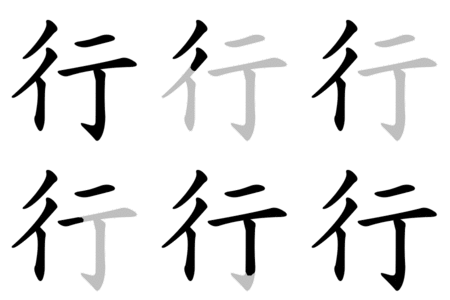 | ||
In the Kangxi Dictionary, there are 53 characters (out of 49,030) to be found under this radical.
行 is not used as an indexing component (radical) in Simplified Chinese. Characters with this radical are classified under radical 彳 (No. 60 in the Kangxi Dictionary; No. 41 in the Table of Indexing Chinese Character Components) in Simplified Chinese.
Evolution
 Oracle bone script character
 Bronze script character
 Large seal script character
 Small seal script character
Derived characters
| Strokes | Characters |
|---|---|
| +0 | 行 |
| +3 | 衍 衎 |
| +4 | 衏 |
| +5 | 衐 衑 衒 術 衔SC (=銜 -> 金) |
| +6 | 衕 衖 街 衘 (=銜 -> 金) |
| +7 | 衙 |
| +9 | 衚 衛 衜 衝 |
| +10 | 衞HK (=衛) 衟 (=道 -> 辵) 衠 衡 |
| +18 | 衢 |
Literature
- Fazzioli, Edoardo (1987). Chinese calligraphy : from pictograph to ideogram : the history of 214 essential Chinese/Japanese characters. calligraphy by Rebecca Hon Ko. New York: Abbeville Press. ISBN 0-89659-774-1.
- Lunde, Ken (Jan 5, 2009). "Appendix J: Japanese Character Sets" (PDF). CJKV Information Processing: Chinese, Japanese, Korean & Vietnamese Computing (Second ed.). Sebastopol, Calif.: O'Reilly Media. ISBN 978-0-596-51447-1.

This article is issued from Wikipedia. The text is licensed under Creative Commons - Attribution - Sharealike. Additional terms may apply for the media files.