Rhamnaceae
Rhamnaceae is a large family of flowering plants, mostly trees, shrubs, and some vines, commonly called the buckthorn family.[2] Rhamnaceae is included in the order Rosales.[3]
| Rhamnaceae | |
|---|---|
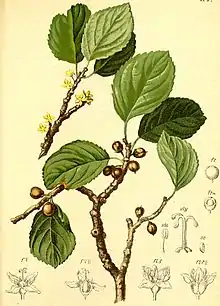 | |
| Rhamnus pumila Turra | |
Scientific classification  | |
| Kingdom: | Plantae |
| Clade: | Tracheophytes |
| Clade: | Angiosperms |
| Clade: | Eudicots |
| Clade: | Rosids |
| Order: | Rosales |
| Family: | Rhamnaceae Juss. |
| Type genus | |
| Rhamnus | |
| Genera | |
|
See text | |
 | |
| The range of Rhamnaceae. | |
| Synonyms | |
|
Frangulaceae DC. | |
The family contains about 55 genera and 950 species.[4] The Rhamnaceae have a worldwide distribution, but are more common in the subtropical and tropical regions. The earliest fossil evidence of Rhamnaceae is from the Late Cretaceous. Fossil flowers have been collected from the Upper Cretaceous of Mexico and the Paleocene of Argentina.[5]
Leaves of family Rhamnaceae members are simple, i.e., the leaf blades are not divided into smaller leaflets.[2] Leaves can be either alternate or opposite. Stipules are present. These leaves are modified into spines in many genera, in some (e.g. Paliurus spina-christi and Colletia cruciata) spectacularly so. Colletia stands out by having two axillary buds instead of one, one developing into a thorn, the other one into a shoot.
_IMG_7432.JPG.webp)
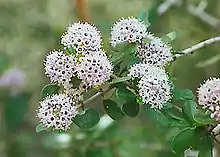
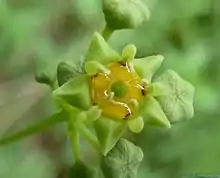
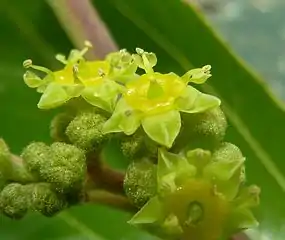
The flowers are radially symmetrical. There are 5 (sometimes 4) separate sepals and 5 (sometimes 4 or none) separate petals. The petals may be white, yellowish, greenish, pink or blue, and are small and inconspicuous in most genera, though in some (e.g. Ceanothus) the dense clusters of flowers are conspicuous. The 5 or 4 stamens are opposite the petals.[2] The ovary is mostly superior, with 2 or 3 ovules (or one by abortion).
The fruits are mostly berries, fleshy drupes, or nuts. Some are adapted to wind carriage, but most are dispersed by mammals and birds. Chinese jujube is the fruit of the jujube tree (Ziziphus zizyphus) and is a major fruit in China.
The American genus Ceanothus, which has several showy ornamental species, has nitrogen-fixing root nodules.[6]
Economic uses of the Rhamnaceae are chiefly as ornamental plants and as the source of many brilliant green and yellow dyes. The wood of Rhamnus was also the most favoured species to make charcoal for use in gunpowder before the development of modern propellants.
.jpg.webp) Alphitonia ponderosa
Alphitonia ponderosa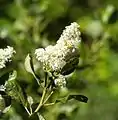 Ceanothus
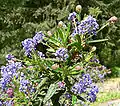 Ceanothus papillosus var. roweanus at the Regional Parks Botanic Garden, Berkeley, California
Genera
- Tribe Ampelozizipheae
- Ampelozizyphus Ducke
- Tribe Bathiorhamneae
- Bathiorhamnus Capuron
- Tribe Colletieae
- Adolphia Meisn.
- Colletia Comm. ex Juss.
- Discaria Hook.
- Kentrothamnus Suess. & Overkott
- Ochetophila Poepp. ex Reissek
- Retanilla (DC.) Brongn.
- Trevoa Miers ex Hook.
- Tribe Doerpfeldieae
- Doerpfeldia Urb.
- Tribe Gouanieae
- Alvimiantha Grey-Wilson
- Crumenaria Mart.
- Gouania Jacq.
- Helinus E.Mey. ex Endl.
- Johnstonalia Tortosa (originally named Johnstonia; by some treated as Gouania)
- Pleuranthodes Weberb.
- Reissekia Endl.
- Tribe Maesopsideae
- Maesopsis Engl.
- Tribe Paliureae
- Hovenia Thunb.
- Paliurus Mill.
- Ziziphus Mill.
- Sarcomphalus P.Browne emend. Hauenschild
- Tribe Phyliceae
- Nesiota† Hook.f. Extinct (2003)
- Noltea Rchb.
- Phylica L.
- Trichocephalus Brogn.
- Tribe Pomaderreae
- Blackallia C.A.Gardner
- Cryptandra Sm.
- Papistylus Kellermann, Rye & K.R.Thiele
- Polianthon K.R.Thiele
- Pomaderris Labill.
- Serichonus K.R.Thiele
- Siegfriedia C.A.Gardner
- Spyridium Fenzl
- Stenanthemum Reissek
- Trymalium Fenzl
- Tribe Rhamneae
- Auerodendron Urb.
- Berchemia Neck. ex DC.
- Berchemiella Nakai
- Condalia Cav.
- Frangula Mill.
- Karwinskia Zucc.
- Krugiodendron Urb.
- Reynosia Griseb.
- Rhamnella Miq.
- Rhamnidium Reissek
- Rhamnus L.
- Sageretia Brongn.
- Scutia (Comm. ex DC.) Brongn.
- Tribe Ventilagineae
- Incertae sedis
- Alphitonia Endl. (close to Colubrina)
- Araracuara Fern.Alonso
- Ceanothus L. (close to Pomaderreae)
- Chaydaia Pit. (by some treated as Rhamnella)
- Colubrina Rich. ex Brongn.
- Emmenosperma F.Muell. (close to Colubrina)
- Granitites Rye[7] (close to Alphitonia)
- Hybosperma Urb. (by some treated as Colubrina)
- Jaffrea H.C.Hopkins & Pillon
- Lasiodiscus Hook.f.
- Schistocarpaea F.Muell.[8] (maybe belonging to Colletieae)
Systematics
Modern molecular phylogenetics recommend the following clade-based classification of Rhamnaceae:[9]
| |||||||||||||||||||||||||||||||||||||||||||||||||||||||||||||||||||||||||||||||||||||||||||||||||||||||||||||||||||||||||||||||||||||||||||||||||||||||||||||||||||||||||||||||||||||||||||||||||||||||||||||||||||||||||||||||||||||||||||||||||||||||||||||||||||||||||||||||
References
- "Family: Rhamnaceae Juss., nom. cons". Germplasm Resources Information Network. United States Department of Agriculture. 2003-01-17. Archived from the original on 2011-06-05. Retrieved 2011-01-29.
- Flowering Plants of the Santa Monica Mountains, Nancy Dale, 2nd Ed. 2000, p. 166
- Walter S. Judd and Richard G. Olmstead (2004). "A survey of tricolpate (eudicot) phylogenetic relationships". American Journal of Botany. 91 (10): 1627–1644. doi:10.3732/ajb.91.10.1627. PMID 21652313. (full text )
- Christenhusz, M. J. M., and Byng, J. W. (2016). "The number of known plants species in the world and its annual increase". Phytotaxa. 261 (3): 201–217. doi:10.11646/phytotaxa.261.3.1.
{{cite journal}}: CS1 maint: multiple names: authors list (link) - Jud, Nathan A.; Gandolfo, Maria A.; Iglesias, Ari; Wilf, Peter (2017-05-10). "Flowering after disaster: Early Danian buckthorn (Rhamnaceae) flowers and leaves from Patagonia". PLOS ONE. 12 (5): e0176164. Bibcode:2017PLoSO..1276164J. doi:10.1371/journal.pone.0176164. ISSN 1932-6203. PMC 5425202. PMID 28489895.
- Kummerow, Jochen; Alexander, James V.; Neel, James W.; Fishbeck, Kathleen (January 1978). "Symbiotic Nitrogen Fixation in Ceanothus Roots". American Journal of Botany. 65 (1): 63–69. doi:10.1002/j.1537-2197.1978.tb10836.x. JSTOR 2442555.
- "Granitites". FloraBase. Western Australian Government Department of Biodiversity, Conservation and Attractions.
- "GRIN Genera of Rhamnaceae". Germplasm Resources Information Network. United. Archived from the original on 2015-09-24. Retrieved 2011-01-29.
- Sun M, Naeem R, Su J-X, Cao Z-Y, J. Burleigh G, Soltis PS, Soltis DE, Chen Z-D. (2016). "Phylogeny of the Rosidae: A dense taxon sampling analysis". Journal of Systematics and Evolution. 54 (4): 363–391. doi:10.1111/jse.12211.
{{cite journal}}: CS1 maint: uses authors parameter (link)
External links
 |
Wikimedia Commons has media related to Rhamnaceae. |
 |
Wikispecies has information related to Rhamnaceae. |
