Sinopa
Sinopa ("swift fox") is a genus of hyaenodontid mammal from family Sinopidae, that lived in North America and Asia during the early to middle Eocene.[11][12]
| Sinopa Temporal range: Early to Middle Eocene | |
|---|---|
 | |
| Sinopa major skeleton | |
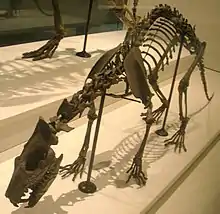 | |
| Sinopa rapax skeleton | |
Scientific classification  | |
| Kingdom: | Animalia |
| Phylum: | Chordata |
| Class: | Mammalia |
| Order: | †Hyaenodonta |
| Family: | †Sinopidae |
| Genus: | †Sinopa Leidy, 1871 |
| Type species | |
| †Sinopa rapax Leidy, 1871 | |
| Species | |
| Synonyms[7] | |
|
synonyms of genus:
synonyms of species:
| |
Description
Sinopa was a small genus of hyaenodontid mammals. Its carnassial teeth were the second upper molar and the lower third. Sinopa species had an estimated weight of 1.33 to 13.97 kilograms.[13] The type specimen was found in the Bridger formation in Uinta County, Wyoming, and existed 50.3 to 46.2 million years ago.
Taxonomy
The putative African species "Sinopa" ethiopica from Egypt was considered a species of Metasinopa by Savage (1965), although Holroyd (1994) considered it a potential new genus related to Quasiapterodon.[14]
Phylogeny
The phylogenetic relationships of genus Sinopa are shown in the following cladogram.[15][16][17][18][19]
| †Hyaenodonta |
|
†Lahimia clade †Sinopa clade †Arfia clade †Galecyon clade †Indohyaenodon clade †Tritemnodon clade | ||||||||||||||||||||||||||||||||||||||||||||||||||||||||||||||||||||||||||||||||||||||||||||||||||||||||||||||||||||||||||||||||||||||||||||||||||||||||||||||||||||||||||||||||||||||||||||||||||||||||||||||||||||||||||||||||||||||||||||||||||||||||||||||||||||||||||||||||||||||||||||||||||||||||||||||||||||||||||||||||
References
- M. Morlo, K. Bastl, W. Wu and S. F. K. Schaal (2014.) "The first species of Sinopa (Hyaenodontida, Mammalia) from outside of North America: implications for the history of the genus in the Eocene of Asia and North America." Palaeontology 57(1):111-125
- W. D. Matthew (1909.) "The Carnivora and Insectivora of the Bridger Basin, middle Eocene." Memoirs of the American Museum of Natural History 9:289-567
- O. A. Peterson (1919.) "Report Upon the Material Discovered in the Upper Eocene of the Uinta Basin by Earl Douglas in the Years 1908-1909, and by O. A. Peterson in 1912." Annals of Carnegie Museum 12(2):40-168
- J. L. Wortman (1902.) "Studies of Eocene Mammalia in the Marsh Collection, Peabody Museum." The American Journal of Science, series 4 14(79):17-23
- T. M. Bown (1982.) "Geology, Paleontology, and Correlation of Eocene Volcaniclastic Rocks, Southeast Absaroka Range, Hot Springs County, Wyoming." United States Geological Survey Professional Paper 1201-A:A1-A75
- E. D. Cope (1872.) "Second account of new Vertebrata from the Bridger Eocene." Proceedings of the American Philosophical Society (separate) 1-3
- J. Alroy (2002.) "Synonymies and reidentifications of North American fossil mammals."
- L. Van Valen (1965.) "Some European Proviverrini (Mammalia, Deltatheridia)." Palaeontology 8(4):638-665
- E. P. Gustafson (1986.) "Carnivorous mammals of the Late Eocene and Early Oligocene of Trans-Pecos Texas." Texas Memorial Museum Bulletin 33:1-66
- E. D. Cope (1871.) "Descriptions of some new Vertebrata from the Bridger Group of the Eocene." Proceedings of the American Philosophical Society 12:460-465
- "Sinopa". The Paleobiology Database. Retrieved 3 May 2011.
- Tomiya, S.; Zack, S. P.; Spaulding, M.; Flynn, J. J. (2021). "Carnivorous mammals from the middle Eocene Washakie Formation, Wyoming, USA, and their diversity trajectory in a post-warming world". Journal of Paleontology. 95 (Supplement S82): 1–115. doi:10.1017/jpa.2020.74.
- Egi, Naoko (2001). "Body mass estimates in extinct mammals from limb bone dimensions: the case of North American hyaenodontids" (PDF). Palaeontology. 44 (3): 497–528.
{{cite journal}}: CS1 maint: uses authors parameter (link) - Lewis, M. E., Morlo, M. (2010): Creodonta. – In : Werdelin, L., Sanders, W. (eds), Cenozoic Mammals of Africa. University of California Press, Berkeley, pp. 543–560. https://doi.org/10.1525/california/9780520257214.003.0026
- G. F. Gunnell (1998.) "Creotonda." In C. M. Janis, K. M. Scott, and L. L. Jacobs (eds.), "Evolution of Tertiary Mammals of North America, Volume 1: Terrestrial Carnivores, Ungulates, and Ungulate like Mammals"
- Borths, Matthew R; Stevens, Nancy J (2017). "Deciduous dentition and dental eruption of Hyainailouroidea (Hyaenodonta, "Creodonta," Placentalia, Mammalia)". Palaeontologia Electronica. 20 (3): 55A. doi:10.26879/776.
- Matthew R. Borths; Nancy J. Stevens (2019). "Simbakubwa kutokaafrika, gen. et sp. nov. (Hyainailourinae, Hyaenodonta, 'Creodonta,' Mammalia), a gigantic carnivore from the earliest Miocene of Kenya". Journal of Vertebrate Paleontology. 39 (1): e1570222. doi:10.1080/02724634.2019.1570222.
- Floréal Solé; Bernard Marandat; Fabrice Lihoreau (2020). "The hyaenodonts (Mammalia) from the French locality of Aumelas (Hérault), with possible new representatives from the late Ypresian". Geodiversitas. 42 (13): 185–214. doi:10.5252/geodiversitas2020v42a13.
- Solé, F.; Morlo, M.; Schaal, T.; Lehmann, T. (2021). "New hyaenodonts (Mammalia) from the late Ypresian locality of Prémontré (France) support a radiation of the hyaenodonts in Europe already at the end of the early Eocene". Geobios. in press. doi:10.1016/j.geobios.2021.02.004. ISSN 0016-6995.
 Media related to Sinopa at Wikimedia Commons