Utaurora
Utaurora is an extinct genus of opabiniid, which were bizarre stem-arthropods closely related to true arthropods and radiodonts; the type species is U. comosa. The animal's fossils come from the Cambrian of Utah.[1]
| Utaurora Temporal range: Middle Cambrian, ~ | |
|---|---|
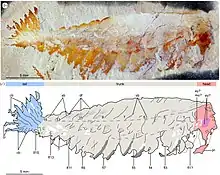 | |
| Holotype specimen of Utaurora comosa (KUMIP 314087) | |
Scientific classification  | |
| Kingdom: | Animalia |
| Phylum: | Arthropoda |
| Class: | †Dinocaridida |
| Family: | †Opabiniidae |
| Genus: | †Utaurora Pates et al., 2022 |
| Type species | |
| †Utaurora comosa Pates et al., 2022 | |
History of study
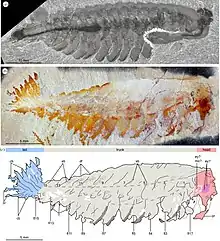
The holotype specimen of Utaurora comosa, KUMIP 314087, was collected from the Wheeler Formation in Utah. It was initially described as a specimen of Anomalocaris in 2008. In 2022, Pates et al. reinterpreted the specimen as an opabiniid and described it as a new genus and species.[2]
Etymology
Utaurora is a portmanteau of Utah, in reference to where the specimen was found, and Aurora, the name of a Roman goddess. The reference to Aurora was chosen as she is a goddess of the dawn who turned her lover into an insect, and Utaurora is an early species close to the origin of arthropods. The species name is Latin for "hairy" or "leafy", and refers to the appearance of the animal, with a hairy-looking dorsal surface and leaf-like arrangement of caudal blades.[3]
Description
 Reconstruction
 Size estimation
 Cross section
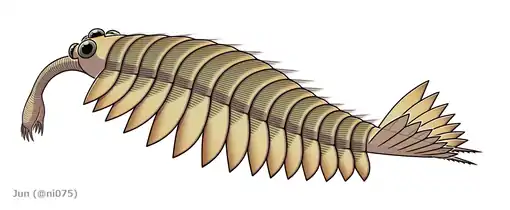
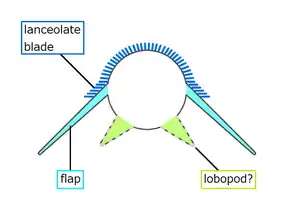
Utaurora closely resembles Opabinia, a bizarre organism from the Burgess Shale with 5 eyes and a proboscis terminated with a pair of appendages. Due to the incomplete discovery, it is uncertain whether Utaurora have these features as well. Utaurora differs from Opabinia in having more extensive setal blades covering its back and promixal region of each lateral flaps (covering only lateral flaps in Opabinia), giving it a hairy appearance, and in having a tail fan composed of at least 7 pairs of caudal blades (3 in Opabinia).[3]
Classification
| ||||||||||||||||||||||||||||||||||||||||||||||||||||||||||||||||||||||||||||||||||||||||||||||||||||||
| Phylogenetic position of Utaurora within Panarthropoda, according to the original description.[4] Opabiniidae is highlighted in pink. |
Based on its similarity to Opabinia, the discoverers of Utaurora classified it in Opabiniidae. Their phylogenetic analyses generally found support for an opabiniid position.[5] A third possible opabiniid, Myoscolex is known from rocks of the Emu Bay Shale in South Australia.[6] However, because morphological features supporting this classification are controversial,[4] a hypothesis has been put forward suggesting It may also have been an early worm.[7]
References
- Tamisiea, Jack (8 February 2022). "One of Evolution's Oddest Creatures Finds a Fossilized Family Member - Opabinia, which swam the seas of Earth's Cambrian era some 500 million years ago, was not just a one hit wonder". The New York Times. Retrieved 10 February 2022.
- Pates et al. 2022, p. 3–5.
- Pates et al. 2022, p. 3.
- Pates et al. 2022.
- Pates et al. 2022, p. 6–7.
- Briggs, D. E. G.; Nedin, C. (1997). "The Taphonomy and Affinities of the Problematic Fossil Myoscolex from the Lower Cambrian Emu Bay Shale of South Australia". Journal of Paleontology. 71 (1): 22–32. doi:10.1017/S0022336000038919. JSTOR 1306537.
- Dzik, Jerzy (2004). "Anatomy and relationships of the Early Cambrian worm Myoscolex". Zoologica Scripta. 33 (1): 57–69. doi:10.1111/j.1463-6409.2004.00136.x. ISSN 1463-6409.
Works cited
- Pates, Stephen; Wolfe, Joanna M.; Lerosey-Aubril, Rudy; Daley, Allison C.; Ortega-Hernández, Javier (9 February 2022). "New opabiniid diversifies the weirdest wonders of the euarthropod stem group". Proceedings of the Royal Society B: Biological Sciences. 289 (1968). doi:10.1098/rspb.2021.2093.