Archaeopterodactyloidea
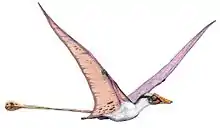
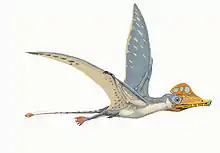
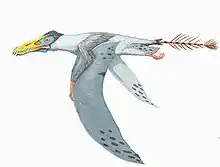
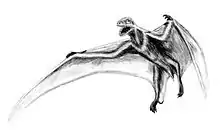
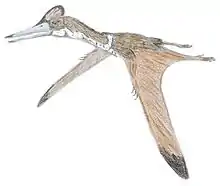
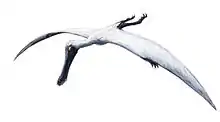
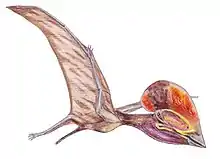
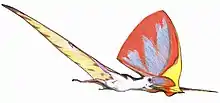
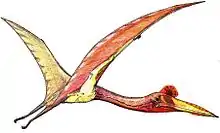
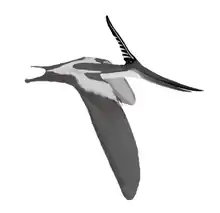
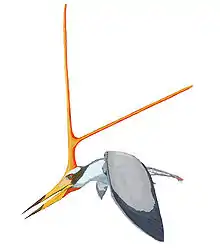
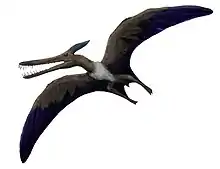
Archaeopterodactyloidea (meaning "ancient Pterodactyloidea") is an extinct clade of pterodactyloid pterosaurs that lived from the middle Late Jurassic to the latest Early Cretaceous periods (Kimmeridgian to Albian stages) of Africa, Asia, Europe and North America.[2] It was named by Alexander Wilhelm Armin Kellner in 1996 as the group that contains Germanodactylus, Pterodactylus, the Ctenochasmatidae and the Gallodactylidae. In 2003, Kellner defined the clade as a node-based taxon consisting of the last common ancestor of Pterodactylus, Ctenochasma and Gallodactylus and all its descendants. Although phylogenetic analyses that based on David Unwin's 2003 analysis do not recover monophyletic Archaeopterodactyloidea, phylogenetic analyses that based on Kellner's analyses, or the analyses of Brian Andres (2008, 2010, 2018) recover monophyletic Archaeopterodactyloidea at the base of the Pterodactyloidea.[3]
| Archaeopterodactyloids | |
|---|---|
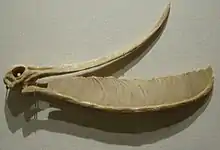 | |
| Restored skull of the ctenochasmatid Pterodaustro guinazui | |
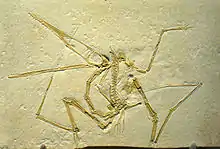 | |
| Cast of the sub-adult type specimen of Pterodactylus antiquus, an archaeopterodactyloid. | |
Scientific classification  | |
| Kingdom: | Animalia |
| Phylum: | Chordata |
| Order: | †Pterosauria |
| Suborder: | †Pterodactyloidea |
| Infraorder: | †Archaeopterodactyloidea Kellner, 1996 |
| Subgroups | |
Classification
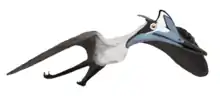
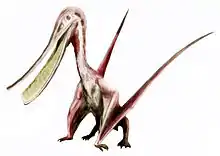
Below is cladogram following a topology recovered by Brian Andres, using the most recent iteration of his data set (Andres, 2021). Andres' analysis found Pterodactylus to be a close relative of the ctenochasmatoids.[4]
| Pterodactyloidea |
| |||||||||||||||||||||||||||||||||||||||||||||
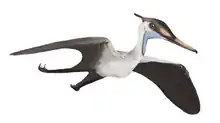
In 2017, Steven Vidovic and David Martill recovered a significantly different set of relationships for early pterodactyloids in their own analysis, as shown below.[1]
| Pterodactyloidea |
| ||||||||||||||||||||||||||||||
References
- Vidovic, S.U.; Martill, D.M. (2018). "The taxonomy and phylogeny of Diopecephalus kochi (Wagner, 1837) and "Germanodactylus rhamphastinus" (Wagner, 1851)". Geological Society, London, Special Publications. 455: 125–147. doi:10.1144/SP455.12.
- Richard J. Butler; Stephen L. Brusatte; Brian B. Andres; Roger B. J. Benson (2012). "How do geological sampling biases affect studies of morphological evolution in deep time? A case study of the Pterosauria (Reptilia: Archosauria)". Evolution. 66 (1): 147–162. doi:10.1111/j.1558-5646.2011.01415.x. PMID 22220871.
- Andres, Brian Blake (2010). Systematics of the Pterosauria. Yale University. p. 366. A preview that shows the cladogram without clade names
- Andres, B. (2021) Phylogenetic systematics of Quetzalcoatlus Lawson 1975 (Pterodactyloidea: Azhdarchoidea). Journal of Vertebrate Paleontology, 41:sup1, 203-217. DOI: 10.1080/02724634.2020.1801703 https://www.tandfonline.com/doi/full/10.1080/02724634.2020.1801703