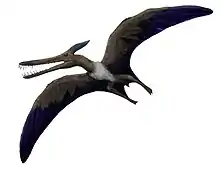
Javelina azhdarchid
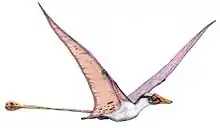
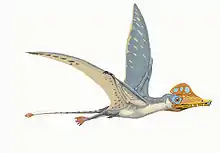
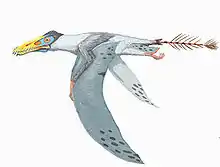
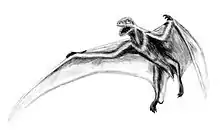
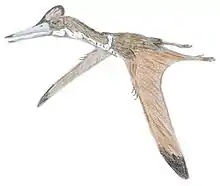
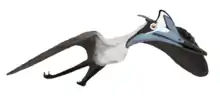
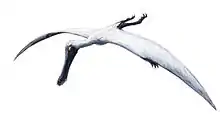
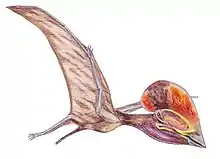
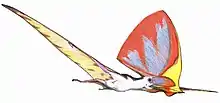
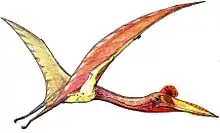
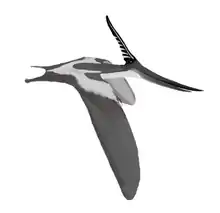
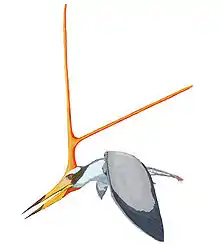
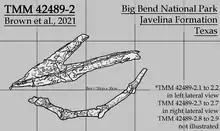
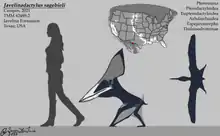
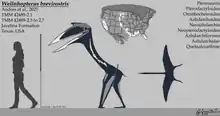
The Javelina azhdarchid is an informal name given to a specimen of azhdarchoid pterosaur recovered from the Late Cretaceous Javelina Formation in Texas. It consists of a set of upper and lower jaws (TMM 42489-2), as well as some cervical vertebrae (TMM 42489-2.3 to 42489-2.8) and a fragmentary long bone (TMM 42489-2.9). In July 2021, the jaws were given the genus name Javelinadactylus (IPA: [xɑːveːliːnɑːˈdæktɪlʌs], meaning "Javelina Finger"), with the type and only species as J. sagebieli.[1] In a paper published in December 2021, the complete holotype was also independently named Wellnhopterus (IPA: [vɛlnˈhɔptərʌs], meaning Wellnhofer's wing), with the only species being W. brevirostris.[2]
Discovery and naming
In March 1986, jaws and neck vertebrae of a large pterosaur were discovered in Brewster County by preparator Robert Rainey. In 1991, Peter Wellnhofer illustrated the find by a picture in his The Illustrated Encyclopedia of Pterosaurs and in the photo caption assigned it to Quetzalcoatlus sp.[3] Accordingly, his illustrator John Sibbick reconstructed Quetzalcoatlus with a too blunt snout, a mistake repeated in many popular science works. In 1996, Alexander Kellner and Wann Langston jr. pointed out that the remains dated from older layers than those which had produced Quetzalcoatlus sp. and represented a form with a shorter snout and neck.[4] In 2004, Kellner, limiting himself to the skull material which he reconstructed, stated that it was a member of the Tapejaridae.[5] In 2006, David Michael Martill and Darren Naish concluded that the snout resembled that of Tupuxuara more than that of Quetzalcoatlus and referred to the taxon as the "Javelina Tupuxuara".[6] In 2012, the fossils were studied by Brian Andres whose cladistic analysis recovered the taxon as a member of the Azhdarchidae, both when the neck vertebrae were included and when only the skull material was entered.[7] In 2013, Mark Witton similarly favoured an azhdarchid interpretation over a thalassodromid one, comparing it to other "blunt-jawed" azhdarchids.[8]
In August 2021, the type species Javelinadactylus sagebieli was named and described by Hebert Bruno Nascimento Campos. The generic name combines a reference to the Javelina Formation with a Latinised Greek daktylos ("finger"), a usual suffix in the names of pterosaurs. The specific name honours James Christopher Sagebiel, head vertebrate fossils collection of the University of Texas. It is the second pterosaur species named from the latest Cretaceous of Texas, after Quetzalcoatlus.[1] The holotype, TMM 42489-2, was found in a layer of the Javelina Formation dating from the middle Maastrichtian. It consists of the front of the paired premaxillae, the paired maxillae and jugals, the front of the mandibular symphysis of the lower jaws and the dentary rami. The remains had been partially articulated. The neck vertebrae, specimens TMM 42489-2.3 to 2.7, were in early 2021 not considered to be part of the holotype.[1]
Later, in December, the complete specimen, including the jaws and the cervical vertebrae, were independently named by Brian Andres and posthumously Wann Langston Jr. as the type species of a short-snouted azhdarchid, Wellnhopterus brevirostris. The generic name, Wellnhopterus is Wellnhofer’s name combined with the Greek pteron, meaning "Wellnhofer's wing", and the specific name, brevirostris (IPA: [brɛvɪˈrɒstrɪs]) meaning "short-beaked" is a combination of the Latin words brevis, meaning short, and rostrum, meaning beak, in reference to its description in the literature as a “short-faced animal”.[2]
Classification
A cladistic analysis in the Javelinadactylus study found the taxon to be a thalassodromine (which the describer assigns to the family Tapejaridae). It was unique in that it in 2021 was the only tapejarid and thalassodromine known from the Maastrichtian, and the only one known from North America. Other members of Thalassodrominae were only known from the much older Romualdo Formation of Brazil.[1] The Wellnhopterus study instead recovered the taxon as an azhdarchid.[2]
Phylogeny after Campos, 2021:[1]
| Azhdarchoidea |
| ||||||||||||||||||||||||||||||||||||||||||||||||||||||||||||||||||||||||||||||
Phylogeny after Andres, 2021:[9]
| Azhdarchoidea |
| |||||||||||||||||||||||||||||||||||||||||||||||||||||||||||||||||||||||||||||||||
Paleobiology
Regardless of its specific phylogenetic placement, the "Javelina azhdarchid" was likely raptorial, as both "blunt-jawed" azhdarchids and thalassodromids are thought to have been specialised to hunt proportionally large prey.[10][11][12]
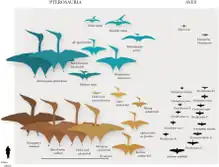
Its co-existence with Quetzalcoatlus and a possible additional pterosaur taxon have been used as examples of pterosaur diversity being higher in the Maastrichtian than traditionally thought.[13]
References
- Campos, H. B. N. (July 31, 2021). "A new azhdarchoid pterosaur from the Late Cretaceous Javelina Formation of Texas". Biologia. doi:10.1007/s11756-021-00841-7.
- Brian Andres; Wann Langston Jr. (14 December 2021). "Morphology and taxonomy of Quetzalcoatlus Lawson 1975 (Pterodactyloidea: Azhdarchoidea)". Journal of Vertebrate Paleontology. 41 (sup1): 142. doi:10.1080/02724634.2021.1907587. ISSN 0272-4634. Retrieved 8 December 2021.
- Wellnhofer, P. 1991. The Illustrated Encyclopedia of Pterosaurs. London: Salamander Books, Ltd. p. 144
- Kellner, Alexander W. A.; Langston, Wann Jr. (June 5, 1996). "Cranial remains of Quetzalcoatlus (Pterosauria, Azhdarchidae) from Late Cretaceous sediments of Big Bend National Park, Texas". Journal of Vertebrate Paleontology. 16 (2): 222–231. doi:10.1080/02724634.1996.10011310.
- Kellner, A. W. A. (2004). "New information on the Tapejaridae (Pterosauria, Pterodactyloidea) and discussion of the relationships of this clade". Ameghiniana. 41 (4): 521–534. ISSN 1851-8044.
- Martill, D. M.; Naish, D. (2006). "Cranial crest development in the Azhdarchoid pterosaur Tupuxuara, with a review of the genus and tapejarid monophyly". Palaeontology. 49 (4): 925–941. doi:10.1111/j.1475-4983.2006.00575.x. S2CID 15609202.
- Andres, B. & Myers, T.S. 2012. "Lone Star Pterosaurs". Earth and Environmental Science Transactions of the Royal Society of Edinburgh, 103(3-4): 383–398
- Mark P. Witton (2013), Pterosaurs: Natural History, Evolution, Anatomy, Princeton University Press, ISBN 978-0-691-15061-1
- Andres, Brian (2021-12-14). "Phylogenetic systematics of Quetzalcoatlus Lawson 1975 (Pterodactyloidea: Azhdarchoidea)". Journal of Vertebrate Paleontology. 41 (sup1): 203–217. doi:10.1080/02724634.2020.1801703. ISSN 0272-4634.
- Mark P. Witton (2013), Pterosaurs: Natural History, Evolution, Anatomy, Princeton University Press, ISBN 978-0-691-15061-1
- Pêgas, R. V.; Costa, F. R.; Kellner, A. W. A. (2018). "New Information on the osteology and a taxonomic revision of the genus Thalassodromeus (Pterodactyloidea, Tapejaridae, Thalassodrominae)". Journal of Vertebrate Paleontology. 38 (2): e1443273. doi:10.1080/02724634.2018.1443273. S2CID 90477315.
- Naish, D.; Witton, M.P. (2017). "Neck biomechanics indicate that giant Transylvanian azhdarchid pterosaurs were short-necked arch predators". PeerJ. 5: e2908. doi:10.7717/peerj.2908. PMC 5248582. PMID 28133577.
- Longrich, N.R.; Martill, D.M.; Andres, B.; Penny, D. (2018). "Late Maastrichtian pterosaurs from North Africa and mass extinction of Pterosauria at the Cretaceous-Paleogene boundary". PLOS Biology. 16 (3): e2001663. doi:10.1371/journal.pbio.2001663. PMC 5849296. PMID 29534059.