Kansaignathus
Kansaignathus (meaning "jaw from Kansai") is a genus of velociraptorine dromaeosaurid from the Late Cretaceous Ialovachsk Formation of Tajikistan. The genus contains a single species, Kansaignathus sogdianus.[1]
| Kansaignathus Temporal range: Santonian ~ | |
|---|---|
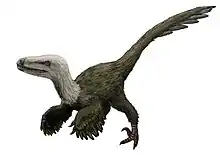 | |
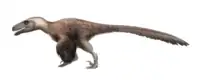
| Life restoration | |
Scientific classification  | |
| Kingdom: | Animalia |
| Phylum: | Chordata |
| Clade: | Dinosauria |
| Clade: | Saurischia |
| Clade: | Theropoda |
| Family: | †Dromaeosauridae |
| Clade: | †Eudromaeosauria |
| Subfamily: | †Velociraptorinae |
| Genus: | †Kansaignathus Averianov & Lopatin, 2021 |
| Species: | †K. sogdianus |
| Binomial name | |
| †Kansaignathus sogdianus Averianov & Lopatin, 2021 | |
| External image | |
|---|---|
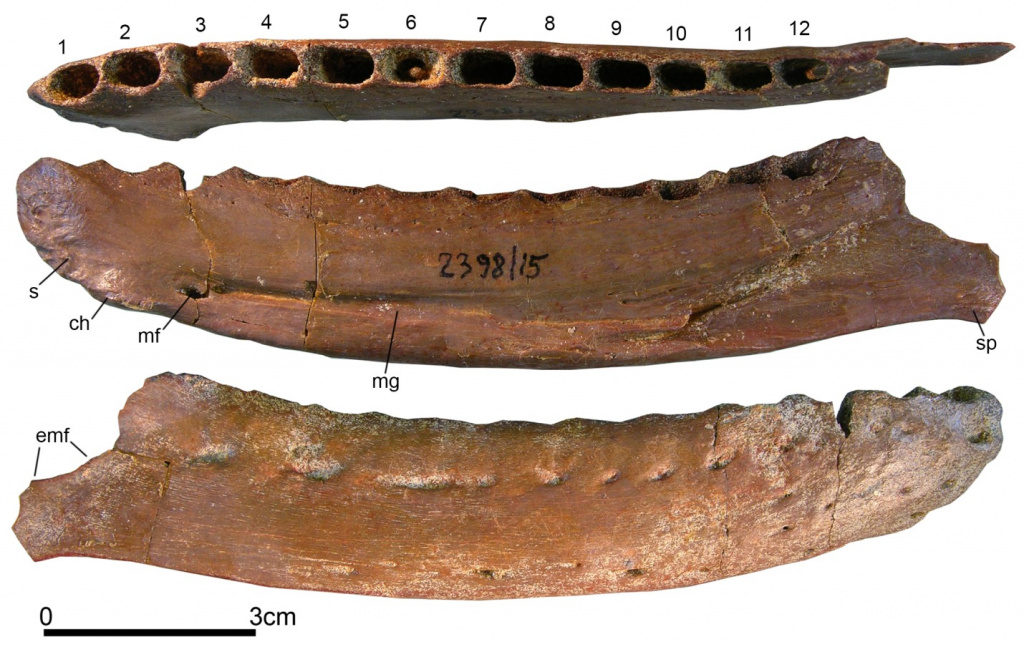
 Right dental bone (PIN holotype, no. 2398/15). The numbers indicate the dental alveoli from front to back. Right dental bone (PIN holotype, no. 2398/15). The numbers indicate the dental alveoli from front to back. |
Discovery and naming
The holotype of Kansaignathus, 2398/15, consists of a right dentary. It was discovered in the Konsoy locality in the north of the Fergana Valley of Tajikistan in the 1960s. The generic name, Kansaignathus, is derived from "Kansai," the Russian name of the location where the holotype specimen was discovered, and the Greek "gnathos," meaning jaw. The specific name, sogdianus, is derived from Sogdiana, an ancient region in Central Asia. It represents the first non-avian dinosaur described from Tajikistan.[1]
Classification
Kansaignathus was placed as a basal member of the subfamily Velociraptorinae by Averianov & Lopatin in 2021. Their cladogram is shown below:[1][2]
| Dromaeosauridae |
| ||||||||||||||||||||||||||||||||||||||||||||||||||||||||||||||||||||||||||||||||||||||||||||||||
References
- Averianov, A. O.; Lopatin, A. V. (2021). "A New Theropod Dinosaur (Theropoda, Dromaeosauridae) from the Late Cretaceous of Tajikistan". Doklady Earth Sciences. 499 (1): 570–574. doi:10.1134/S1028334X21070047. S2CID 239088573..
- "Научная работа - Палеонтологический институт им. А.А. Борисяка РАН".
.png.webp)
.jpg.webp)