Hassiacosuchus
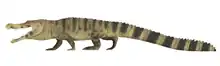
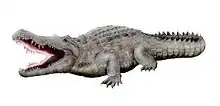
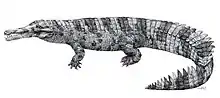
Hassiacosuchus is an extinct genus of small alligatorid from the early Eocene of Germany, found at the Messel pit. It was named in 1935 by K. Weitzel, and the type species is H. haupti.[2] A second species, H. kayi, was named in 1941 by C.C. Mook for material from the Bridgerian (early Eocene) of Wyoming,[3] but was reassigned to Procaimanoidea in 1967 by Wassersug and Hecht.[4] Hassiacosuchus may be the same as Allognathosuchus; Christopher Brochu has recommended continuing to use Hassiacosuchus.[5]
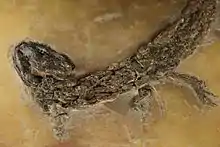
Specimen at the Natural History Museum of Basel
| Hassiacosuchus Temporal range: Eocene, | |
|---|---|
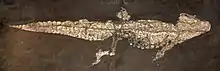 | |
| Fossil, State Museum of Natural History Karlsruhe | |
Scientific classification  | |
| Kingdom: | Animalia |
| Phylum: | Chordata |
| Class: | Reptilia |
| Order: | Crocodilia |
| Family: | Alligatoridae |
| Subfamily: | Alligatorinae |
| Genus: | †Hassiacosuchus Weitzel, 1935 |
| Type species | |
| †Hassiacosuchus haupti Weitzel, 1935 | |
The cladogram below from the 2020 Cossette & Brochu study shows the placement of Hassiacosuchus within Alligatoridae:[6]
| Alligatoroidea |
| |||||||||||||||||||||||||||||||||||||||||||||||||||||||||||||||||||||
| (stem-based group) |
References
- Rio, Jonathan P.; Mannion, Philip D. (6 September 2021). "Phylogenetic analysis of a new morphological dataset elucidates the evolutionary history of Crocodylia and resolves the long-standing gharial problem". PeerJ. 9: e12094. doi:10.7717/peerj.12094. PMC 8428266. PMID 34567843.
- Weitzel, K. (1935). "Hassiacosuchus haupti n. g. n. sp., ein durophages Krokodil aus dem Mitteleozän von Messel". Notizblatt des Vereins für Erdkunde und der Hessischen Geologischen Landesanstalt Darmstadt (in German). 16: 40–49.
- Mook, C.C. (1941). "A new crocodilian, Hassiacosuchus kayi, from the Bridger Eocene beds of Wyoming". Annals of the Carnegie Museum. 28: 207–220.
- Wassersug, R.J.; Hecht, M.K. (1967). "The status of the crocodylid genera Procaimanoidea and Hassiacosuchus in the New World". Herpetologica. 23 (1): 30–34.
- Brochu, Christopher A. (2004). "Alligatorine phylogeny and the status of Allognathosuchus Mook, 1921". Journal of Vertebrate Paleontology. 24 (4): 857–873. doi:10.1671/0272-4634(2004)024[0857:APATSO]2.0.CO;2. ISSN 0272-4634.
- Adam P. Cossette; Christopher A. Brochu (2020). "A systematic review of the giant alligatoroid Deinosuchus from the Campanian of North America and its implications for the relationships at the root of Crocodylia". Journal of Vertebrate Paleontology. 40: e1767638. doi:10.1080/02724634.2020.1767638.
External links
Extinct crocodilians | |||||||||||||||||||||||||||||||||||||||||
|---|---|---|---|---|---|---|---|---|---|---|---|---|---|---|---|---|---|---|---|---|---|---|---|---|---|---|---|---|---|---|---|---|---|---|---|---|---|---|---|---|---|
| |||||||||||||||||||||||||||||||||||||||||
| |||||||||||||||||||||||||||||||||||||||||
| |||||||||||||||||||||||||||||||||||||||||
| |||||||||||||||||||||||||||||||||||||||||
| |||||||||||||||||||||||||||||||||||||||||
This article is issued from Wikipedia. The text is licensed under Creative Commons - Attribution - Sharealike. Additional terms may apply for the media files.