Ocepesuchus
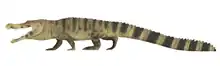
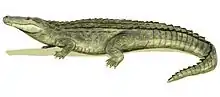
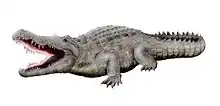
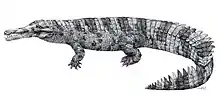
Ocepesuchus (meaning "Ocepe crocodile", in reference to the OCP, or Office Chérifien des Phosphates, a phosphate-mining company that participated in the excavation of the specimen) is an extinct genus of gavialoid crocodilian, related to modern gharials. It lived in the Late Cretaceous of Morocco. Described by Jouve and colleagues in 2008, the type species is O. eoafricanus, with the specific name meaning "dawn African" in reference to its great age relative to other African crocodilians. Ocepesuchus had a long snout with a tubular shape, wider than high. It is the oldest known true crocodilian from Africa.[1][2]
| Ocepesuchus Temporal range: | |
|---|---|
Scientific classification  | |
| Kingdom: | Animalia |
| Phylum: | Chordata |
| Class: | Reptilia |
| Order: | Crocodilia |
| Superfamily: | Gavialoidea |
| Genus: | †Ocepesuchus Jouve et al., 2008 |
| Type species | |
| †Ocepesuchus eoafricanus Jouve et al., 2008 | |
Ocepesuchus is based on OCP DEK-GE 45, a crushed but mostly complete skull from late Maastrichtian (Late Cretaceous)-age rocks in the Oulad Abdoun Basin, in the vicinity of Khouribga, Morocco. The individual is interpreted as a small adult. The end of the snout and part of the bottom surface of the skull are missing. The preserved portion is a little over 25 centimeters long (9.8 in), and about 12 cm (4.5 in) wide at the rear margin, but the snout tapers to less than a third of that. Jouve and colleagues performed a cladistic analysis incorporating their new taxon, and found Ocepesuchus to be a gavialoid.[1]
A 2022 phylogenetic study by Iijima et al. recovered Ocepesuchus within Gavialinae, deeply nested within Gavialoidea, as shown in the cladogram below:[3]
| |||||||||||||||||||||||||||||||||||||||||||||||||||||||||||||||||||||||||||||||||||||||||||||||||||||||||||||||||||||||||||||||||||||||||||||||||||||||||||||||||||||||||||||||||||||||||||||||||||||||||||||||||||||||||||||||
References
- Jouve, Stéphane; Bardet, Nathalie; Jalil, Nour-Eddine; Suberbiola, Xabier Pereda; Bouya; Baâda; Amaghzaz, Mbarek (2008). "The oldest African crocodylian: phylogeny, paleobiogeography, and differential survivorship of marine reptiles through the Cretaceous-Tertiary Boundary". Journal of Vertebrate Paleontology. 28 (2): 409–421. doi:10.1671/0272-4634(2008)28[409:TOACPP]2.0.CO;2.
- Other crocodile-like animals from older strata in Africa, like Sarcosuchus, are not true crocodilians, but related animals.
- Iijima M, Qiao Y, Lin W, Peng Y, Yoneda M, Liu J (2022). "An intermediate crocodylian linking two extant gharials from the Bronze Age of China and its human-induced extinction". Proceedings of the Royal Society B: Biological Sciences. 289 (1970): Article ID 20220085. doi:10.1098/rspb.2022.0085.
Extinct crocodilians | |||||||||||||||||||||||||||||||||||||||||
|---|---|---|---|---|---|---|---|---|---|---|---|---|---|---|---|---|---|---|---|---|---|---|---|---|---|---|---|---|---|---|---|---|---|---|---|---|---|---|---|---|---|
| |||||||||||||||||||||||||||||||||||||||||
| |||||||||||||||||||||||||||||||||||||||||
| |||||||||||||||||||||||||||||||||||||||||
| |||||||||||||||||||||||||||||||||||||||||
| |||||||||||||||||||||||||||||||||||||||||